
"NO!!!"
Australia at the Strategic Inflection Point — and the Indo-Pacific Architecture America Cannot Afford to Lose


Washington DC 2026

(U) EXECUTIVE SUMMARY
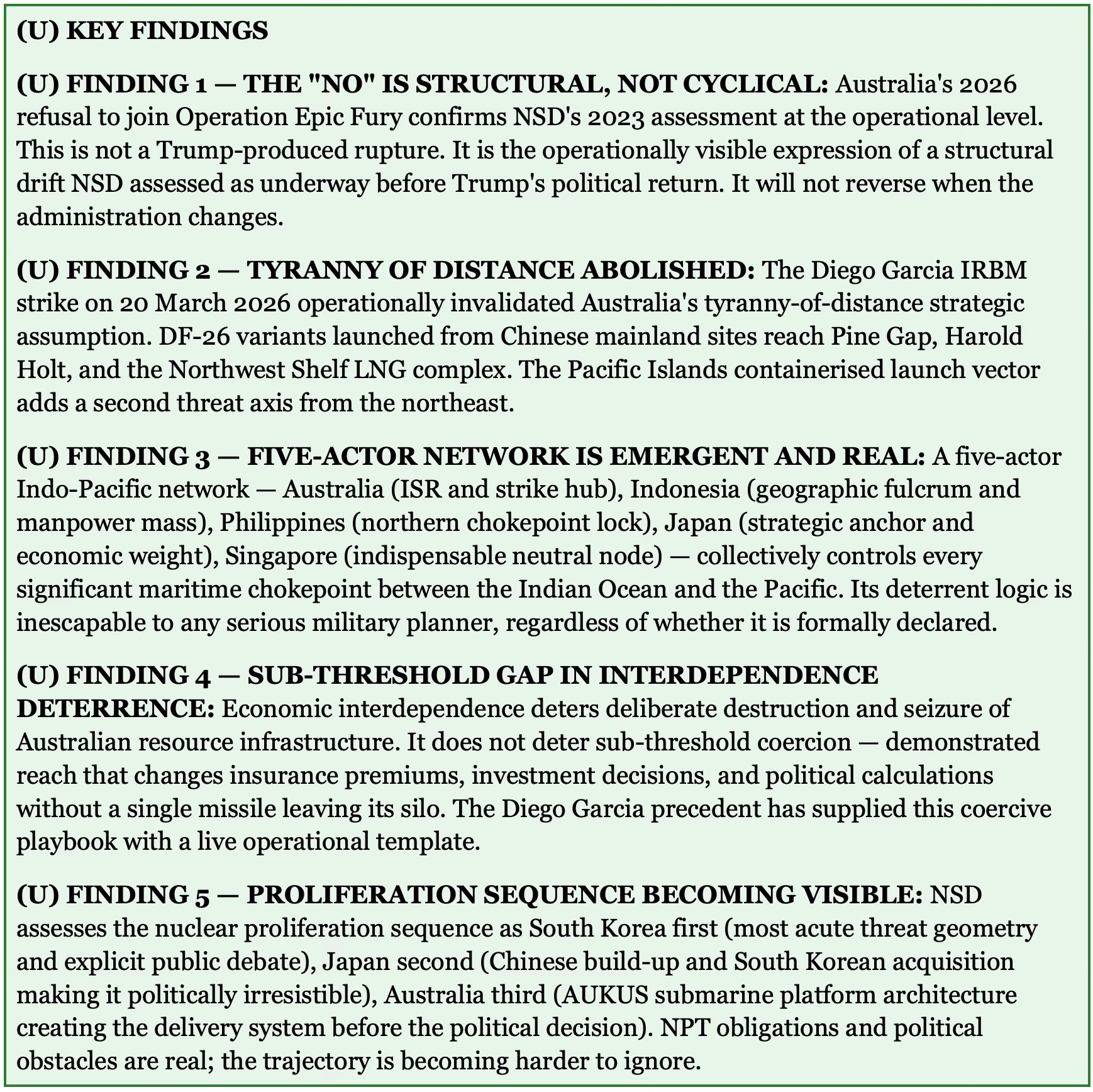
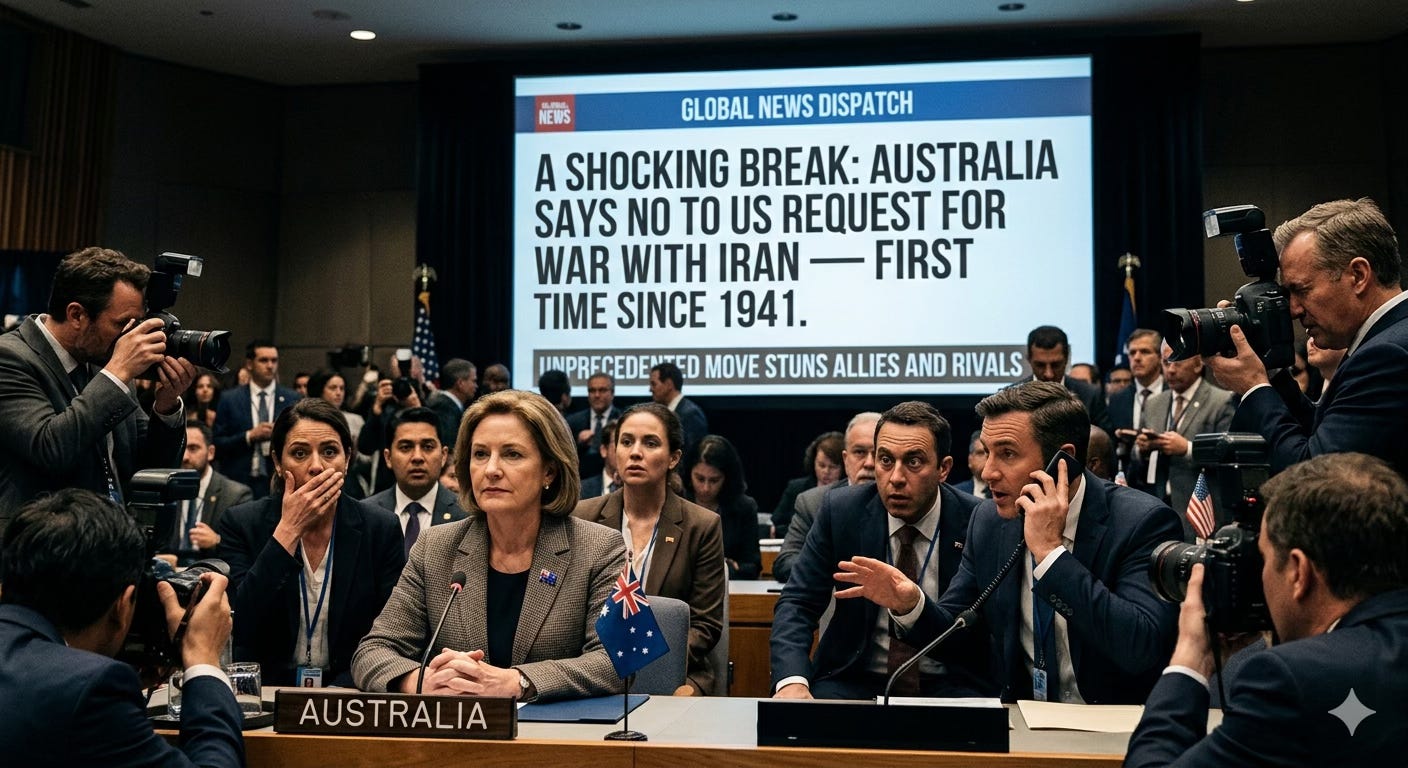
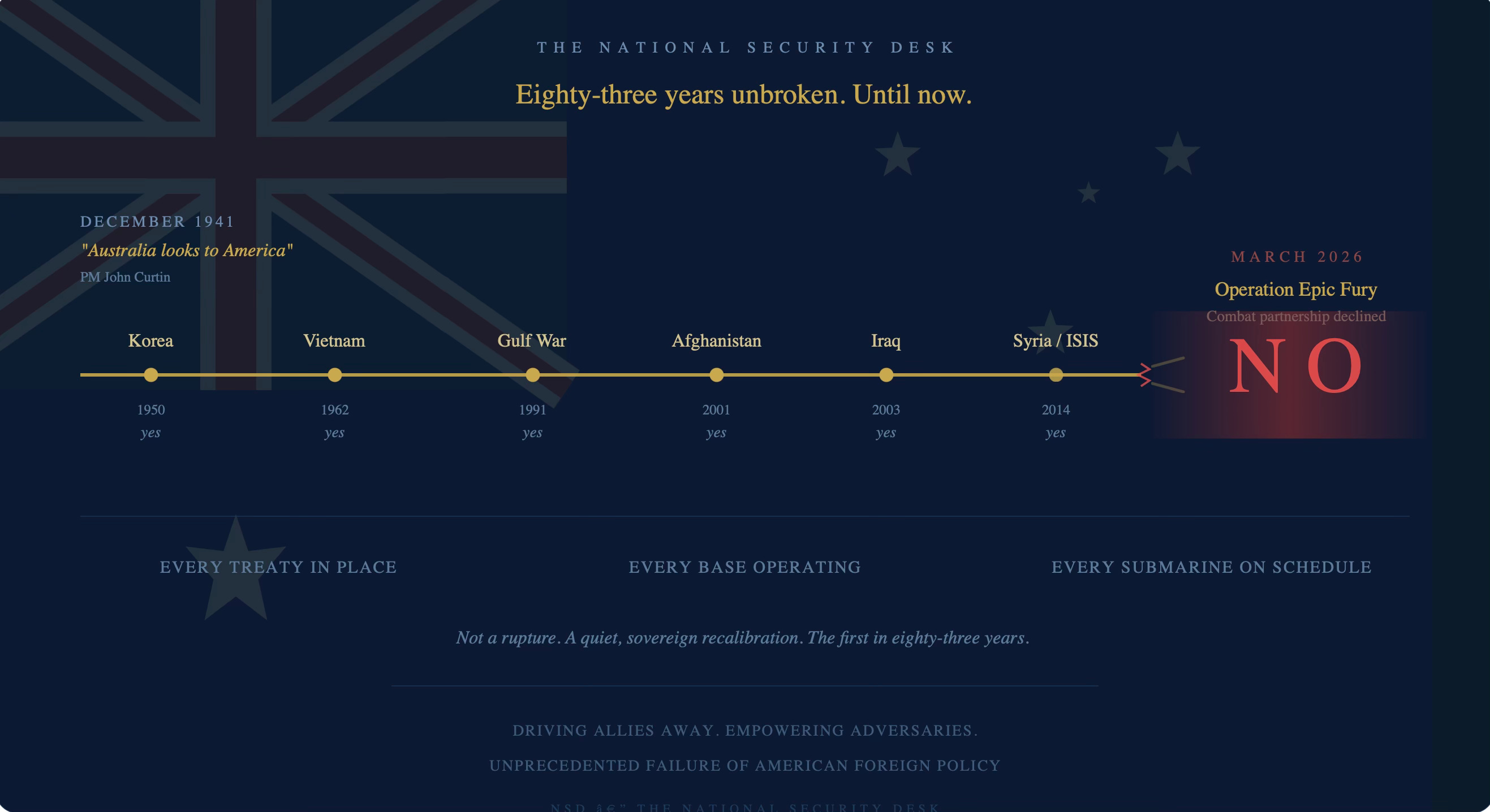
Australia has never said no since 1941. Until now. This is devastating proof of the unprecedented and catastrophic failure of American foreign policy. Driving Allies away and empowering adversaries.
When Washington asked Australia to join Operation Epic Fury as a combat partner, Australia said no.
Not with a formal declaration. Not with a diplomatic rupture. With a quiet, considered, sovereign decision that left every treaty in place, every base operating, every submarine programme on schedule, and the word “no” hanging in the air between Canberra and Washington for the first time in eighty-three years.
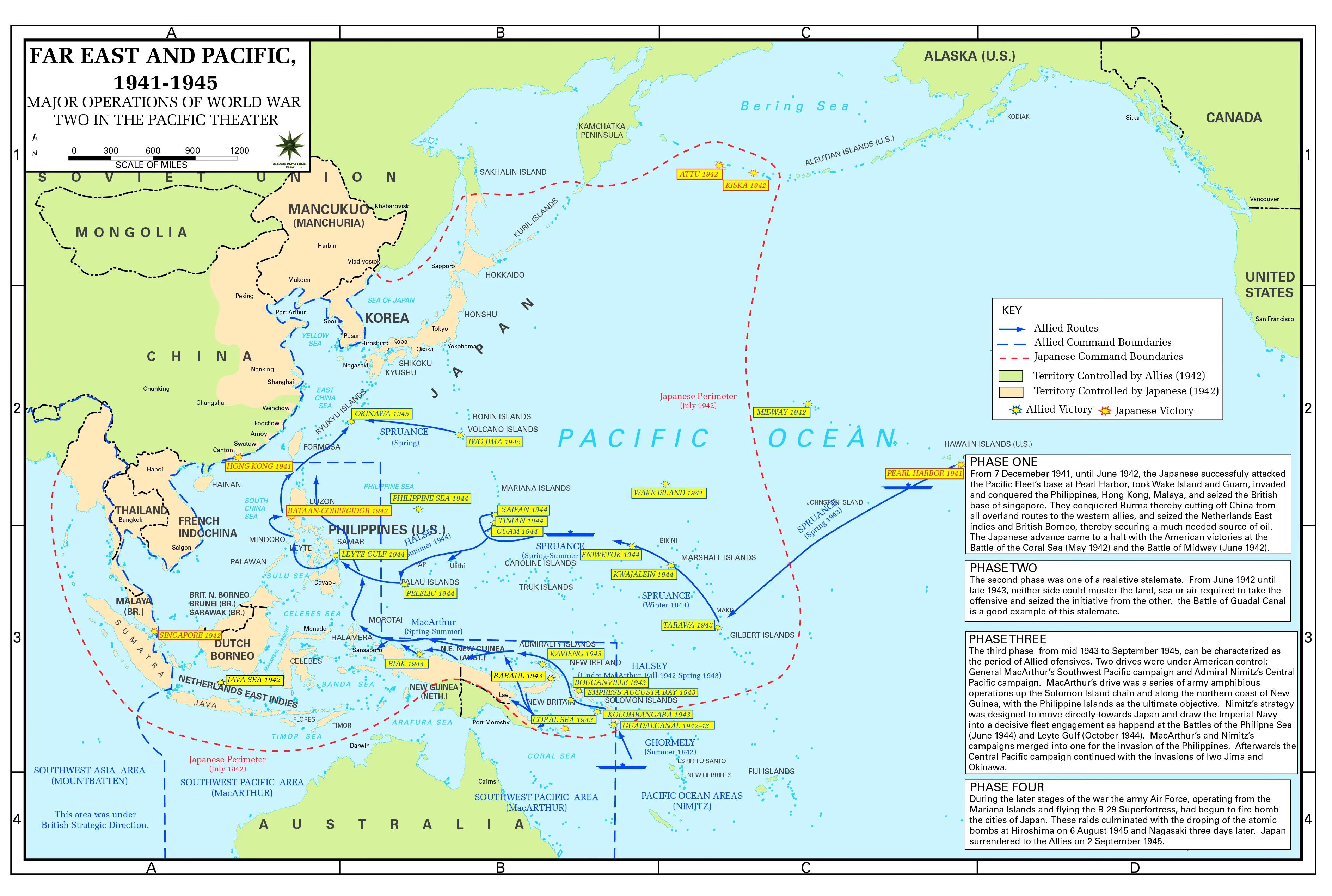
The last time Australia redirected its strategic orientation this fundamentally was December 1941. Imperial Britain’s catastrophic failure to defend Singapore — the fall of the supposedly impregnable fortress in seventy days, the surrender of 130,000 Allied troops, the shattering of the assumption that the Empire would protect its most distant dominion — forced Prime Minister John Curtin to look to America. His statement was unambiguous: Australia looks to America, free of any pangs as to our traditional links or kinship with the United Kingdom. That pivot shaped every Australian strategic decision for the next eighty-three years. Korea. Vietnam. The Gulf War. Iraq. Afghanistan. Every time Washington asked, Canberra said yes.
In 2026, it said no.
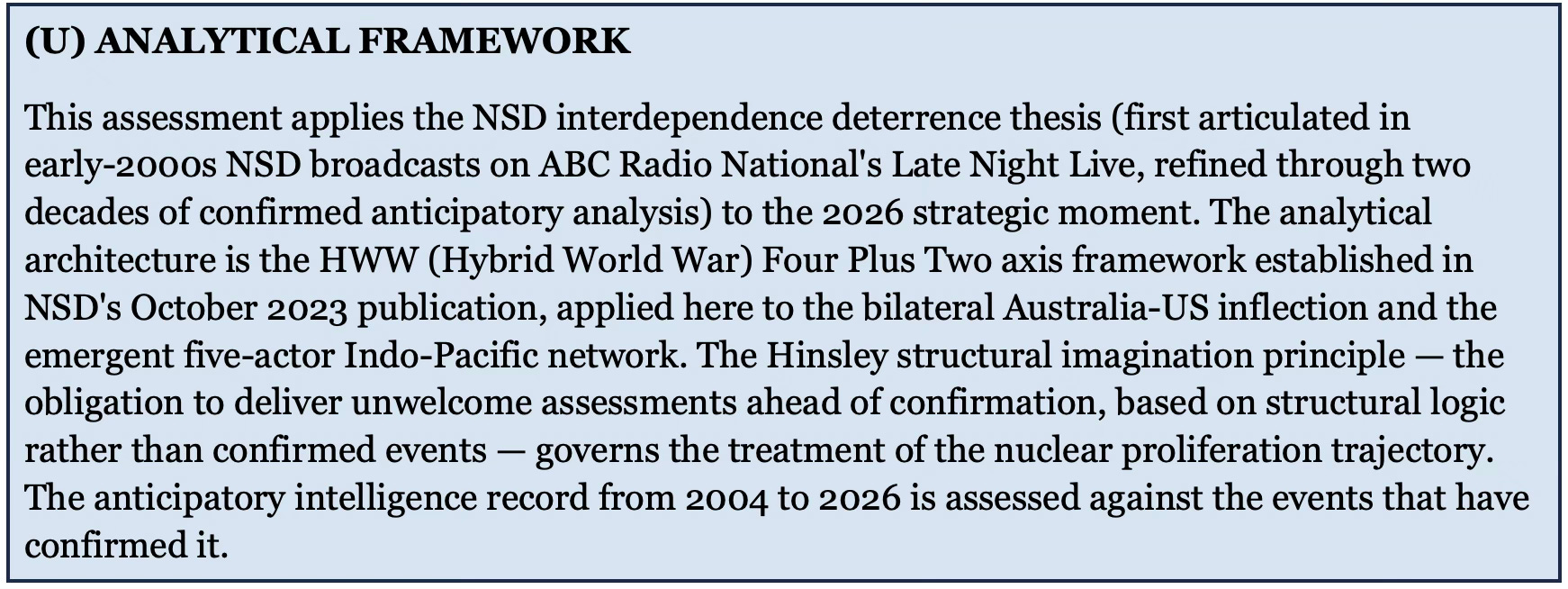
The shock is not simply that it happened. The shock — examined honestly, with the analytical depth the moment demands — is that it was a long time coming. Trump did not cause this. He accelerated it. The structural shift was already underway when NSD’s founding analyst, in the years following the turn of the millennium, appeared on ABC Radio National’s Late Night Live to argue that Australia should consider positioning itself as the “new Switzerland” of the Indo-Pacific — so indispensable as an energy and resource supplier to both the United States and China that attacking it would be economically self-destructive for either great power. The argument received the polite condescension reserved for ideas whose time has not yet come.
It has come. And it has arrived in a form considerably more consequential — and considerably more urgent — than the original framing anticipated.
This piece draws together the analytical threads NSD has been tracking since that broadcast. It does so at the depth the subject demands, because no mainstream analytical forum is connecting them in their full consequence, and because the anticipatory intelligence record on this question is now sufficiently confirmed by events to warrant a comprehensive accounting.
(U) PART I — THE LONG ACCUMULATION: NOT ONLY A TRUMP STORY
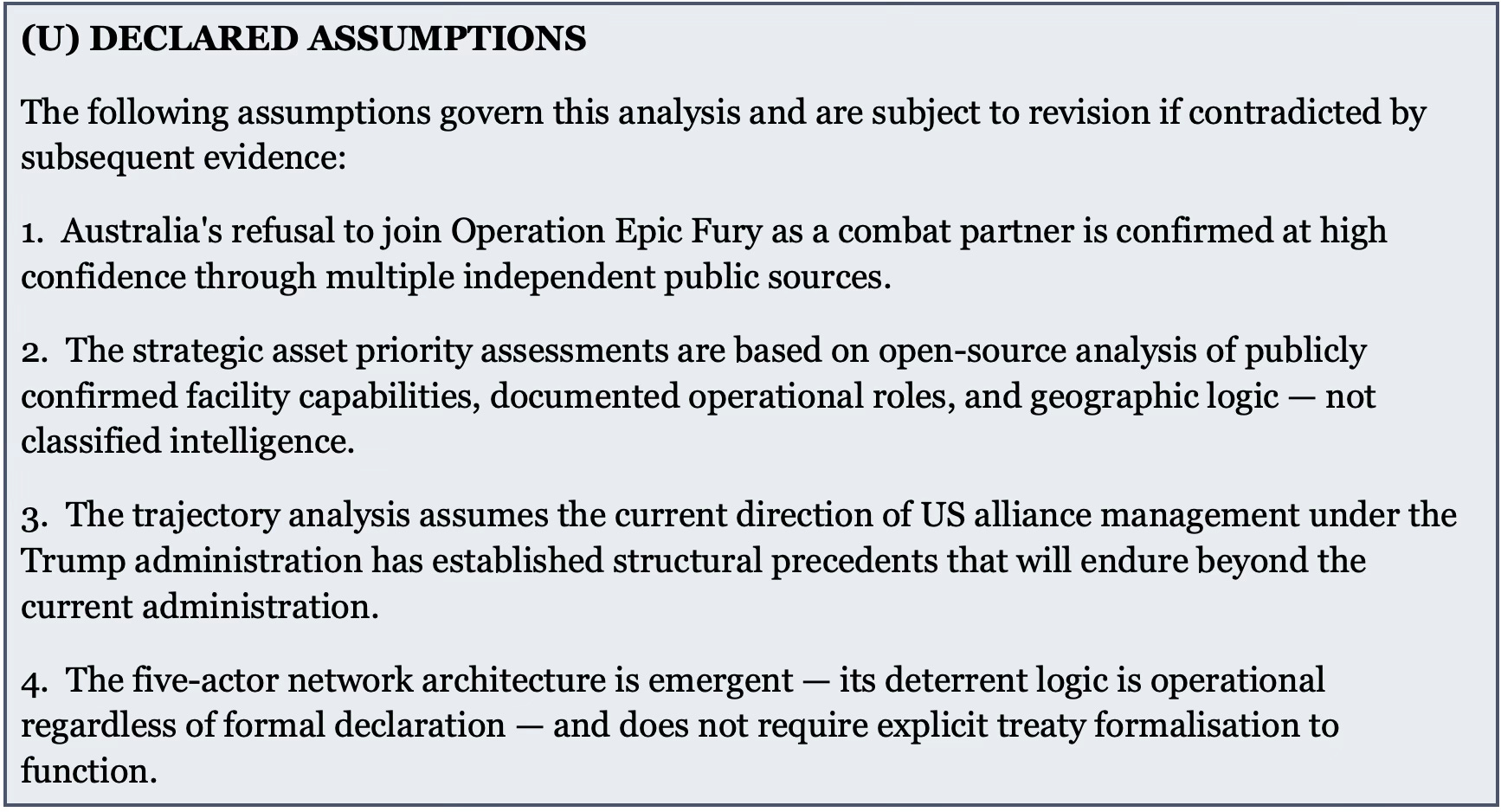
The instinct in Washington — and in the Western commentary that has belatedly noticed Australia’s 2026 posture — is to read it as a Trump problem. A bilateral irritant produced by an aberrant administration, soluble when the political weather changes. This reading is wrong, and the error is consequential. Trump did not cause Australia’s strategic reorientation. He accelerated a process already structurally underway, and that will not reverse when he leaves office.
The interdependence argument NSD advanced in the early 2000s was not a reaction to Trump. It was a reaction to the emergence of China as a peer competitor and the early signs that the American alliance system’s foundational assumptions were becoming brittle. The core thesis — that Australia could achieve strategic autonomy not through military neutrality in the Swiss geographic sense, but through economic indispensability to both great powers simultaneously — was the first articulation in Australian public discourse of what has since become the central preoccupation of Australian strategic debate.
The logic was elegant and, in its primary application, remains correct. Make yourself so necessary to both sides that attacking you destroys what the attacker needs. Switzerland’s neutrality is not maintained by its army alone. It is maintained by the accumulated institutional weight of its banking system, its diplomatic infrastructure, and the recognition by every major power that the cost of disrupting Swiss neutrality exceeds any conceivable gain. The early NSD argument applied that logic to Australian LNG, uranium, and resources: if both great powers depend on Australian supply, neither can afford to interrupt it.
What the intervening two decades have revealed is that the thesis was correct about the mechanism and incomplete about two things: the structural architecture required to make the deterrence credible against the full threat spectrum, and the specific failure mode that pure economic interdependence cannot prevent. Those revelations are the substance of this piece.
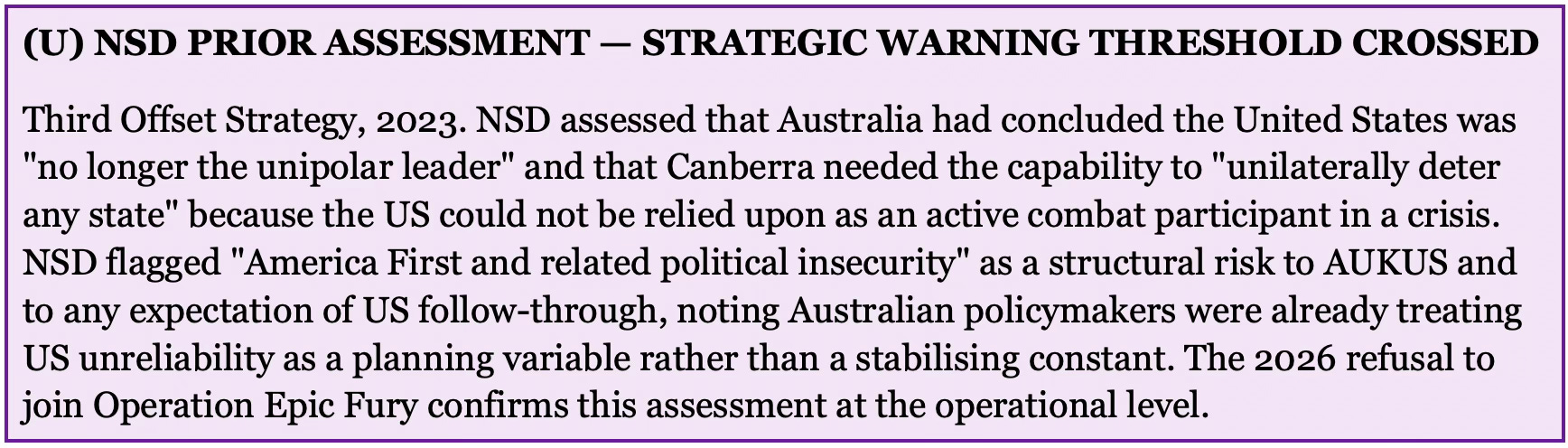

Simultaneously — and this is what the Trump-centric reading misses entirely — the American side of the equation was also deteriorating structurally. The erosion of US extended deterrence credibility was not manufactured by one administration. It accumulated across thirty years of strategic overextension, failed deterrence in Georgia, Ukraine, and the South China Sea, and the progressive narrowing of American conventional and nuclear superiority that USSTRATCOM Commander Admiral Richard described in 2022 as a ship “slowly sinking.” When the US conventional military advantage narrows toward parity with a peer competitor, extended deterrence — the promise that an attack on an ally is equivalent to an attack on the American homeland — loses credibility regardless of who occupies the White House.
Trump is the accelerant applied to a fire already burning. He converted a slow structural drift into a visible rupture by making explicit what was previously implicit: that the United States under his leadership does not recognise the accumulated obligations, intangibles, and mutual strategic investments that have made the alliance system function for seventy-five years. His contribution — declaring he could “just fly in and use” Morón Air Base without Spanish consent, imposing trade sanctions on NATO allies, humiliating the Australian Ambassador on camera, threatening the sovereign territory of a treaty ally in Greenland, attempting to surrender the SACEUR role held by American generals since Eisenhower — is to strip the alliance of the intangible infrastructure that made it worth sustaining.
He cannot imagine those intangibles because his cognitive framework has no category for them. Every relationship is a transaction. Every transaction is today’s transaction. Allied nations have accepted costs, risks, and sovereign constraints across generations in exchange for an American security guarantee whose value was never purely transactional. It was based on mutual interest, shared values, and the accumulated trust of common sacrifice. Trump reduces all of that to a line item. He then expresses bewilderment when the line item produces diminishing returns. What he is destroying is not a set of bilateral arrangements. He is destroying the credibility of the American commitment itself. And once allied publics have internalised that America will sanction you, insult your head of government, threaten your territory, and drag you into wars of choice that are not in your interest — that internalisation does not reverse when the administration changes.
(U) PART II — THE VOICE MAP: A BIPARTISAN FRACTURE FIFTY YEARS IN THE MAKING
Washington tends to read Australian skepticism of the alliance as a Labor phenomenon. This reading has never been accurate and is now actively misleading. The fracture in Australian elite consensus is bipartisan, multi-generational, and runs from former Prime Ministers through the defense establishment’s own think tanks to decorated military veterans.
The most historically significant element is the Fraser-Whitlam convergence. Malcolm Fraser — Liberal Prime Minister from 1975 to 1983, Washington’s most reliable Cold War ally in the region during his tenure — spent his final years arguing in Dangerous Allies that Australia should end its strategic dependence on the United States. His late-career convergence with Gough Whitlam — the Labor Prime Minister whose threat to close Pine Gap in 1974 had brought the alliance to the edge of rupture, and whose removal from office in November 1975 occurred in circumstances that remain among the most contested in Australian political history — was not a personal reconciliation. It was a structural signal of the deepest kind.
The Whitlam-Pine Gap episode established the template that 2026 is reprising. When Whitlam discovered that Pine Gap was a CIA facility operating without his knowledge or consent and threatened to close it, the Nixon White House response was NSSM 204 — a top-secret interagency study asking: can these facilities be relocated? The study’s conclusion was that they were “damned near irreplaceable” and that relocation costs were prohibitive. Nothing has changed about that conclusion. What changed between 1974 and 2026 is that the Australian political conditions that produced the Whitlam confrontation have re-emerged — with a public and elite far more skeptical of the alliance and far more willing to name its asymmetries than at any point in the intervening fifty years.
Two men from opposite ends of Australian political life, divided by the defining rupture of post-war Australian politics, arrived in old age at the same conclusion: the alliance as structured serves American interests more than Australian ones, and Australian strategic sovereignty requires a more independent posture. That convergence is not a footnote. It is the deepest structural signal in Australian political history that this moment was coming.
Paul Keating — Labor Prime Minister 1991-1996 — has been the most substantive contemporary voice. AUKUS turns Australia into “an arm of the US military.” Taiwan is “not a vital Australian interest — we have no alliance with Taipei, none.” The submarine deal serves Washington, not Canberra. Consistent, detailed, credentialed.
Malcolm Turnbull — Liberal Prime Minister 2015-2018 — has publicly warned that the United States is “descending into authoritarianism” under Trump and that Australia cannot assume a stable, like-minded ally in Washington. A Liberal Prime Minister turned public critic of alliance reliability is not a marginal event. It represents the collapse of the bipartisan consensus that once treated the alliance as beyond serious question.
Anthony Albanese — current Prime Minister — has been more careful but the signals are readable. His John Curtin Oration explicitly framed “greater independence” from the United States as Labor’s founding foreign policy tradition. Conservative commentators accused him of trying to provoke Washington into killing off AUKUS. The speech required “careful explanation to our American friends,” in the words of a former US Ambassador, “to avoid a misconception that this was a declaration of independence from the US.” A serving Prime Minister whose public address requires diplomatic management in Washington is a Prime Minister already operating in a different strategic register
.
Senator Jacqui Lambie — eleven-year ADF veteran, decorated soldier, Tasmanian independent — provides the analytically critical Overton window function. In 2025 she called for Australia to “threaten to close Pine Gap” and “order US troops out of Darwin” as direct responses to Trump’s tariffs and diplomatic contempt: “we followed them into the Middle East, we depleted our forces, we made our sacrifices, and they treated us with contempt.” A combat veteran calling for Pine Gap closure carries different political weight than an academic or a Green senator making the same call. She channels the anger of Australia’s veteran community — the people who paid in blood for the alliance’s wars of choice — and that anger has political weight that elite critique does not.
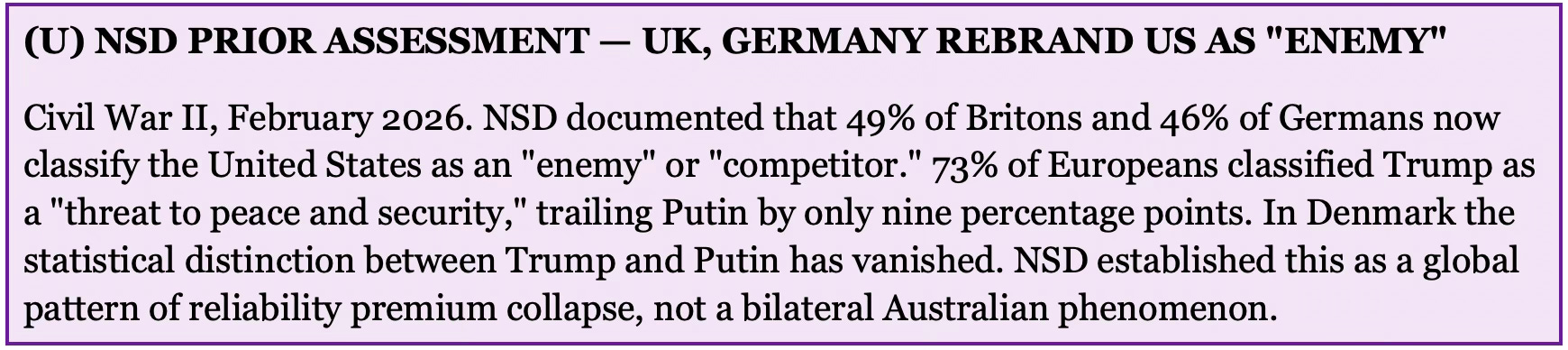
The mechanism NSD has consistently identified: fringe voices normalise positions that mainstream politicians adopt once the polling moves. The polling is moving. The 2025 Lowy Institute Poll found that 40% of Australians said Australia should distance itself from the United States under President Trump — up from around one-third in 2018 — while 57% said Australia should remain close (Lowy Institute, 2025). Trust in America to act responsibly fell 20 points in a single year to 36%, a two-decade low (Lowy Institute, 2025, p. 6). On the question of whether Xi Jinping or Donald Trump is a more reliable partner for Australia, Australians are evenly split — 45% each (Lowy Institute, 2025, pp. 4, 11). That finding has no precedent in twenty years of continuous Lowy polling. Eighty percent still say the US alliance is institutionally important — the accumulated history, the infrastructure, the operational relationships (Lowy Institute, 2025, p. 10). But 45% consider the current President of the United States as reliable as the leader of the Chinese Communist Party. The gap between institutional alliance support and operational trust is the fault line. It is widening structurally, not cyclically.
The global context confirms this is not uniquely Australian. It is a simultaneous collapse across every alliance system the United States built. The reliability premium that has been America’s core strategic asset since 1945 — the reason allies accepted costs, constraints, and risks in exchange for the American security guarantee — is unwinding in real time. Trump did not build it. He is dismantling it faster than any adversary could achieve from outside.
Senator Jacqui Lambie — eleven-year ADF veteran, decorated soldier, Tasmanian independent — provides the analytically critical Overton window function. In 2025 she called for Australia to “threaten to close Pine Gap”
(U) PART III — THE TYRANNY OF DISTANCE INVALIDATED, AND THE INFRASTRUCTURE THAT DOESN’T EXIST
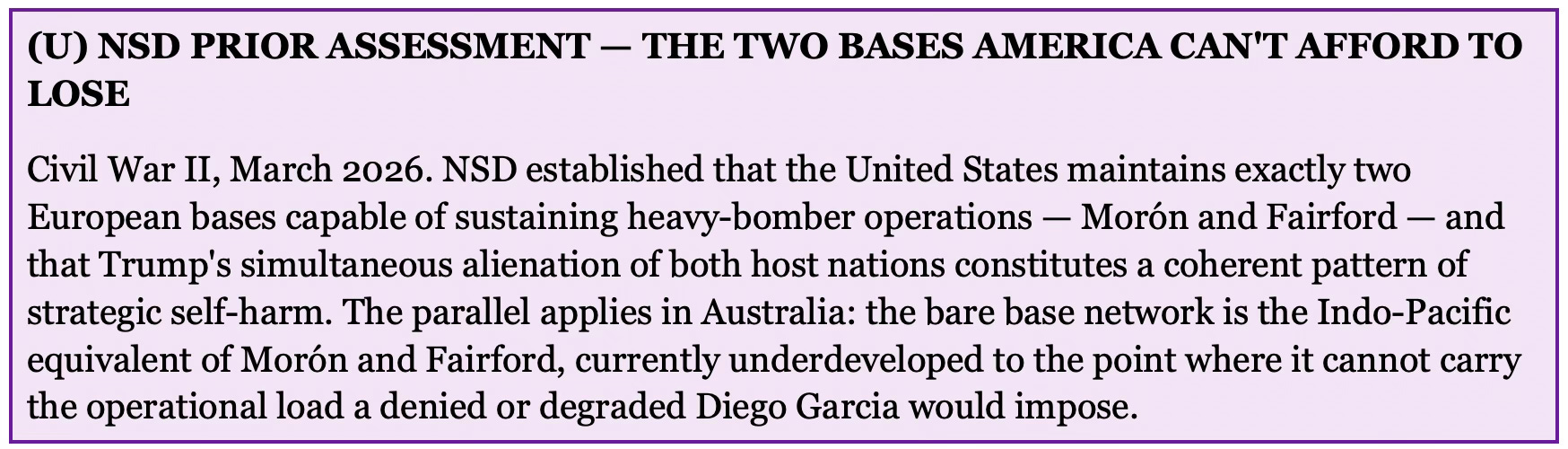
Australian strategic culture has historically rested on an assumption so deeply embedded it rarely needed to be named: distance protects. The continent is vast, remote, and expensive to reach. More precisely, the assumption had two components that reinforced each other. First, projecting conventional military power against Australia at strategic scale required a sustained naval expedition across thousands of kilometers of contested ocean — with all the vulnerability, logistics exposure, and operational warning that entails. Second, Australia was not sufficiently close to the primary theaters of great power competition to justify that cost.
Both assumptions are now operationally invalidated. They died on 20 March 2026 when an Iranian IRBM demonstrated a combat ballistic trajectory of approximately 3,800 to 4,000 kilometers to Diego Garcia. The tyranny of distance that protected Diego Garcia — one of the most remote military installations on earth, positioned in the middle of the Indian Ocean precisely because its isolation was its strategic value — was eliminated not by a naval expedition, not by a sustained air campaign, but by a single missile salvo from a degraded arsenal that US briefers had assessed at 8% residual capability.

One aspect of the tyranny of distance argument survives intact and deserves acknowledgement before we discard the rest: the Brisbane Line logic still holds for any adversary seeking to capture and hold territory. North of Brisbane — the vast northern arc that contains the strategic assets under analysis — is effectively a virtual lunar landscape for an expeditionary ground force. Zero urban infrastructure outside Alice Springs and Darwin. Road networks measured in single-lane dirt tracks across thousands of kilometers of the most demanding terrain on earth. The manpower and logistics requirements of a sustained ground occupation would dwarf anything any adversary has attempted in modern history. No rational military planner would try it. What changed on 20 March 2026 is not this reality. What changed is that an adversary does not need to capture and hold the Northwest. It needs to hold it at risk. Those are operationally different requirements, and the distance argument that defeats the first provides no protection against the second.
The implications for Australia must be stated without softening.
The distance from Chinese mainland launch sites to Australian strategic infrastructure is comparable to or less than the Diego Garcia engagement range. The DF-26 intermediate-range ballistic missile has a range of 3,000 to 4,000 kilometers in standard configuration and up to 5,000 kilometers in extended variants. Launched from Xinjiang province, it reaches Pine Gap, Harold Holt, and Darwin. Launched from southern Chinese coastal sites, it reaches the Northwest Shelf LNG complex and the RAAF bare bases at Learmonth and Curtin. China has held these coordinates in its targeting database for twenty years. What changed on 20 March 2026 is that the operational precedent for using ballistic strike capability against deep-rear economic and military infrastructure was established under combat conditions by a lesser power with a degraded arsenal.
The logic that Iran has demonstrated against Diego Garcia has a corollary that Australian strategic culture has been slow to reach: if mobile ballistic missile capability is the cheapest and most effective tool for holding fixed strategic infrastructure at risk, Australia should be considering whether to acquire it for its own use. A sovereign mobile TEL-based IRBM system — conventional warhead, focused on key Chinese maritime chokepoints, the Spratlys, the Paracel Islands, and South China Sea basing infrastructure — provides deterrence at a cost-exchange ratio that missile defense cannot match. Australia cannot defend its strategic assets missile-for-missile. It can, at best, deter attack by making the cost of the attack prohibitive. A credible offensive strike capability against Chinese assets changes the adversary’s cost calculus in a way that no amount of additional air defense expenditure achieves. This is not consistent with Australian cultural strategic tradition — the tradition of deploying alongside a great power rather than holding sovereign offensive capability against a peer competitor. That tradition requires revision if Australia is to survive in the strategic environment the 2026 moment has revealed.
And the threat is not limited to mainland Chinese launch sites.
China’s diplomatic and economic penetration of Pacific Island states — the security agreement with the Solomon Islands, the strategic facilities agreement with Kiribati, the telecommunications and port infrastructure investments across Vanuatu, PNG, and the broader Pacific — has created a permissive environment in which dual-use infrastructure could host forward-positioned military capability without the host state having either the ISR to detect it or the institutional capacity to contest it. A containerised MRBM or cruise missile launcher — exactly the format Iran has demonstrated for maritime strike capability, exactly the format the Houthi campaign has proven works against defended naval targets in the Red Sea — positioned in the Solomon Islands is approximately 2,000 kilometers from the Australian eastern seaboard. Kiribati sits within cruise missile range of Australia’s northeastern approaches. These are not sophisticated military actors. A dual-use port agreement, a “logistics facility,” a telecommunications contract — the template China has refined across the Indo-Pacific — provides the access without requiring the host government to understand what has been positioned on its soil. The host state may genuinely not know. Its ISR capability is negligible. Its capacity to verify what is stored in a containerised facility at a Chinese-funded port is essentially zero.
This means the tyranny of distance argument has a second front that the mainland launch site analysis doesn’t capture. The IRBM and cruise missile threat to Australia is not only from the northwest, from Xinjiang or the southern Chinese coast. It potentially exists to the northeast and east, from positions already within the Chinese diplomatic and infrastructure orbit, placing Australian eastern population centres and eastern military infrastructure within ranges previously associated only with the western approaches.
The offensive cost of threatening Australian strategic assets has therefore collapsed from two directions simultaneously. What previously required a sustained naval expedition now requires a missile salvo from the mainland or a forward-positioned containerised system from the Pacific island chain. The geography that made Australia strategically remote has not changed. The weapons technology that used to make that geography a meaningful barrier has.
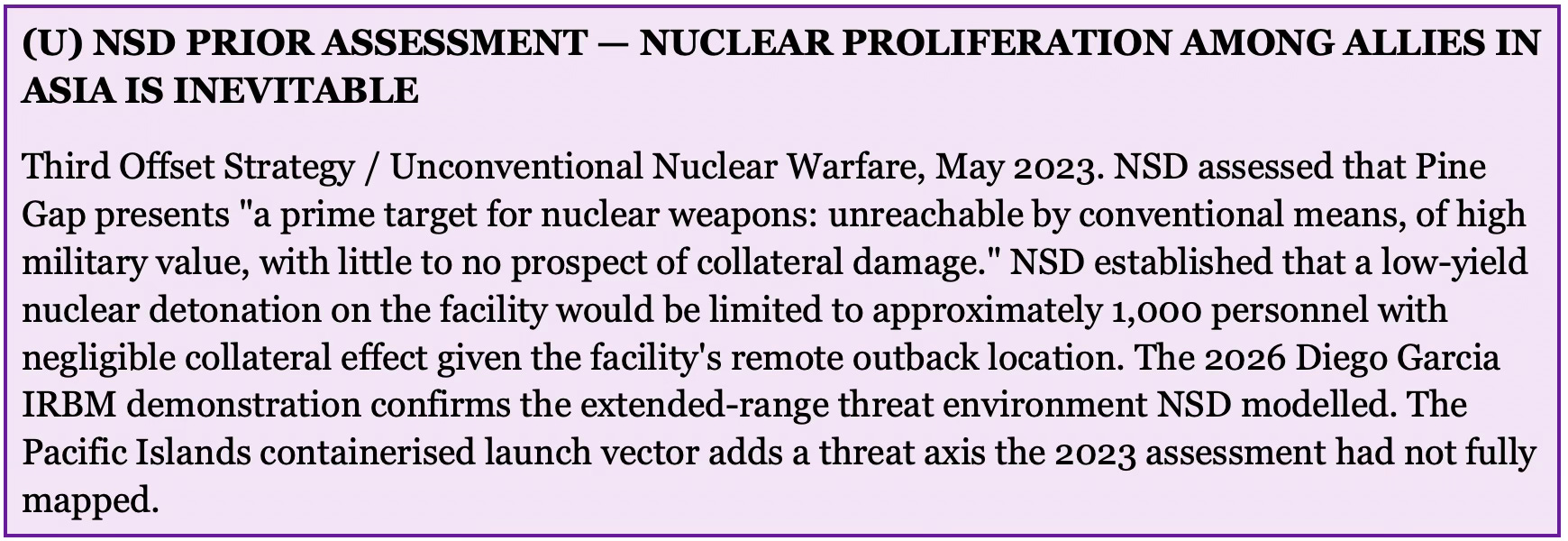
The defensive cost has not changed. Australia is the sixth largest country by area with one of the lowest population densities of any developed nation — approximately 3.3 people per square kilometer — virtually all of that population concentrated into six major coastal cities on the eastern and southern seaboards. Its northwestern strategic assets are spread across a coastline larger than the entire eastern seaboard of the United States, connected by road networks that are, in places, single-lane dirt tracks through one of the most demanding environments on earth. Darwin to Learmonth is approximately 2,700 kilometers by road — a single route with no parallel alternative. This is not an exception. It is the rule for the entire northern zone above the Brisbane Line: one road, and running alongside that road, one fibre optic cable. The communications and logistics infrastructure of Australia’s entire strategic north share a single physical corridor. A precision strike that severs the road severs the cable. The same missile that cuts the supply line cuts the communications network. There is no redundancy. There is no alternative routing. Above the Brisbane Line, Australia’s strategic north is connected to the rest of the country by infrastructure a competent adversary could degrade with a handful of precision strikes — not against the bases themselves, but against the single thread that links them to national command authority and national logistics. In a conflict environment where Chinese long-range precision strike can reach these facilities, the road network is not a viable supply line and the cable corridor is not a survivable communications architecture. The maritime fuel resupply alternative — tankers operating in the Indian Ocean, ship-to-shore transfer to base storage — requires infrastructure that does not currently exist at these locations at operational scale.
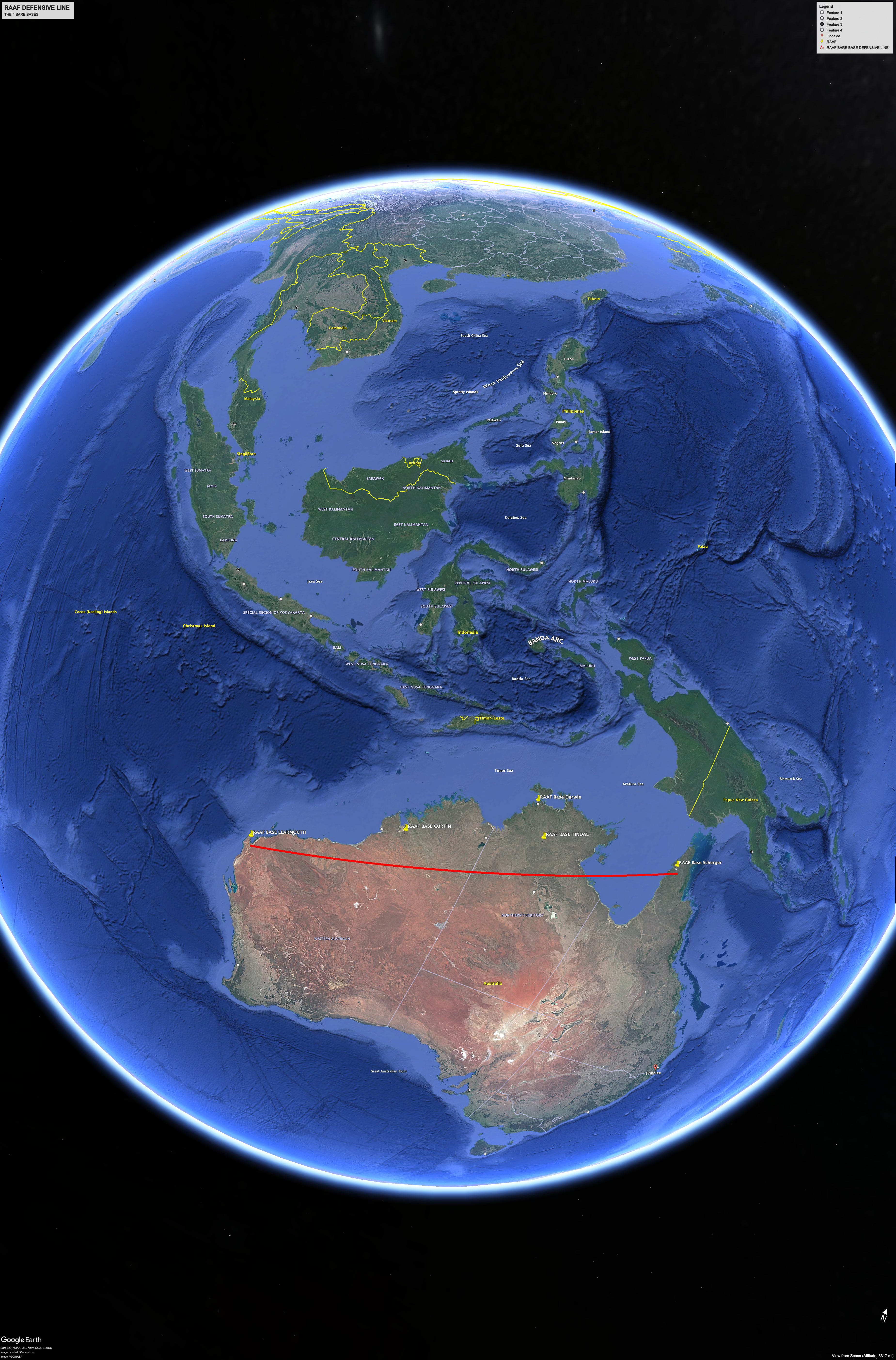
The RAAF bare bases at Learmonth, Curtin, Scherger, and Tindal are exactly what their name suggests. They have runways. They do not have hardened aircraft shelters protecting fifth-generation aircraft from precision ballistic strikes. They do not have buried, protected fuel storage surviving strikes that target above-ground infrastructure. They do not have dispersed ammunition pre-positioning across multiple hardened sites. They do not have the hardened command and communications infrastructure that would survive the electronic warfare environment a serious Chinese operation would generate. And critically — they do not have the ocean-going fuel resupply infrastructure that would allow sustained operations without a functional road network. Offshore mooring buoys. Subsea fuel pipelines from anchorage to shore storage. Hardened pump stations. Sufficient storage capacity to buffer against supply interruption. And — absent all of this — they do not have integrated terminal defense and area denial systems protecting the fuel infrastructure, the hardened shelters, and the maritime resupply terminals from the precision ballistic and loitering munition strikes that would target all of them simultaneously.
None of this exists at the required scale. All of it needs to be built, hardened, and resupply-tested before a crisis, not during one. The investment program required is a decade long and has not seriously begun.
Diego Garcia had most of it. That is precisely why Iran targeted it as a strategic signal — not the runway, but the fuel farms, the Maritime Pre-Positioning Ships, the logistics concentration that sustains US power projection across two combatant commands. The lesson Australia must draw from the Diego Garcia strike is that the specific vulnerability Iran demonstrated exists in more primitive form at every Australian northwestern base. The March 2026 strike has made the investment case strategically urgent in a way that no amount of planning analysis had previously achieved.
The Northwest Shelf LNG infrastructure, the northern bare base network, and the emerging AUKUS submarine industrial base share a common vulnerability that the Diego Garcia template makes explicit: they are single-point-of-failure nodes in supply chains designed for peacetime rather than contested logistics. The Osborne shipyard building AUKUS submarines, the fuel farms and ammunition depots that sustain fifth-generation aircraft at Tindal and Learmonth, and the LNG export infrastructure on the Northwest Shelf cannot be rapidly reconstituted if struck. The skilled workforce and specialized tooling required to repair battle-damaged infrastructure do not exist at scale and cannot be improvised under fire. Iran’s attack — directed at logistics, fuel, and pre-positioned stocks rather than runways — is a template for how adversaries will prioritize these Australian nodes in any serious campaign. The investment program required to harden and disperse this infrastructure is not a peacetime capability improvement. It is an urgent warfighting requirement that the March 2026 strike has made visible to anyone paying attention.

The economic irrelevance assumption has not merely eroded — it has inverted completely. Australia is consistently the 13th to 16th largest economy globally, a significant middle power. More consequentially, its specific resource profile has made it strategically indispensable at exactly the moment when great power competition has made those resources the material foundation of the technology contest between civilizations.
Australia produces approximately 10% of global LNG supply (IEA, 2025). It holds the world’s largest identified uranium reserves. It ranks in the top three globally for lithium, cobalt, and rare earth elements — the irreplaceable inputs to F-35 avionics, Tomahawk guidance systems, satellite platforms, and the semiconductor supply chains that underpin every advanced military system either great power is building. The rare earth processing dimension is the sharpest edge of this picture: Australia holds significant rare earth reserves and produces a meaningful share of global mine output, but China processes approximately 85 to 90% of global rare earth production — including the majority of Australia’s mined ore. Australian rare earths extracted from Australian soil often travel through Chinese processing before reaching Western defense industrial supply chains. Building Australian in-country rare earth processing capacity is not an economic development objective. It is a direct counter to the most consequential Chinese leverage point over Western military production.
The growing Australian defense industry adds the final dimension. A highly educated population of 26 million has been building sovereign defense industrial capacity in exactly the domains where the future of warfare is being decided. Ghost Bat loyal wingman development. The Jindalee Over-The-Horizon Radar Network providing persistent ISR coverage across millions of square kilometers of northern approaches, capable under the right ionospheric conditions of detecting aircraft taking off from Beijing. MQ-4C Triton maritime surveillance. The Integrated Air and Missile Defense program. Australian defense industry is not building tanks. It is building the autonomous systems, the ISR architecture, and the networked kill chain capability that will define the operational character of the next generation of conflict.
Australian Innovation - Ghost Bats - Ghost Sharks - Over the Horizon Radar and
GPS-free navigation
One development that receives insufficient strategic attention in Western analysis: Australia is actively developing non-GPS guidance technology for precision weapons — inertial navigation, terrain-referenced guidance, and alternative positioning systems that function in a communications-denied and GPS-degraded environment. In a conflict scenario where Chinese electronic warfare and anti-satellite capability degrade or eliminate GPS reliability across the theatre, conventional GPS-guided munitions lose their precision advantage. Non-GPS guidance is therefore not a secondary capability. It is a survivability requirement for the entire precision strike architecture on which Australian and allied warfighting depends. Australia’s investment in this domain is a direct investment in alliance resilience against the most likely Chinese asymmetric counter to Western precision strike dominance.
The geographic isolation that once kept Australia far from great power competition has been abolished by the very forces that define great power competition in 2026: rare earth supply chains, LNG pricing, autonomous ISR reach, and ballistic missiles with 4,000-kilometer range. Australia is not far from anything. It is at the centre of everything that matters. And its fixed strategic infrastructure — Pine Gap, Harold Holt, the NW Shelf, the bare bases — now sits within the threat envelope of two separate adversary strike architectures simultaneously.
(U) PART IV — THE VULNERABILITY: THE NORTHWEST SHELF AS DIEGO GARCIA
The interdependence deterrence thesis holds strongly against one threat scenario and inadequately against another. Understanding the distinction is the operational heart of what the 2026 Diego Garcia strike revealed for Australian strategic planning.
Against major conventional assault or deliberate destruction of Australian resource infrastructure, the interdependence argument holds well. A Chinese operation that destroys the Northwest Shelf LNG complex removes from global supply the 10% serving Chinese trading partners in Japan, South Korea, and Europe. It triggers cascading energy price consequences that rebound into Chinese domestic markets. It imposes political costs of attacking civilian infrastructure serving China’s own customers. The self-harm calculation is genuine and the deterrence is real for this scenario.
Against seizure and hold — taking the Northwest Shelf intact and redirecting supply — the geographic argument tells the decisive story. Any Chinese maritime operation aimed at Australia’s northwest must transit approximately 5,000 kilometers of Indonesian archipelagic waters through the Lombok, Makassar, and Karimata Straits. The analysis of that geographic reality belongs in Part V. The point here is structural: seizure requires a logistics sustainability through Indonesian territory that Indonesian strategic interests make operationally implausible.
Against the third scenario — sub-threshold coercion, grey-zone harassment, the use of long-range strike as a political signalling instrument — the interdependence argument provides inadequate protection on its own. China does not need to destroy or seize the Northwest Shelf to achieve meaningful strategic effect against Australian policy. It needs to demonstrate, credibly and repeatedly, that it can hold the infrastructure at risk.
A DF-26 test that splashes in the eastern Indian Ocean within the flight envelope of Northwest Shelf coordinates. Drone and USV harassment of LNG tanker traffic in the approaches to the Dampier Archipelago. Cyber intrusion into SCADA systems controlling Gorgon or Wheatstone processing facilities — not to destroy them, but to demonstrate access that can be activated at will. A containerised system on a Pacific Island — potentially unknown to the host government — that brings eastern Australian targets within range and is revealed through a deliberate intelligence leak rather than a strike. The same playbook Iran ran against Diego Garcia: not destruction, not seizure, but the credible demonstration of reach that changes every insurance premium, every investment decision, every political calculation connected to the facility.
Economic interdependence deters attacks that destroy the asset both parties need. It does not deter coercion that threatens to disrupt access without destroying supply permanently. The disruption effect — raised insurance costs, investor caution, political pressure on Canberra to accommodate Chinese preferences to reduce the implied threat — can be achieved without a single missile leaving its silo. This is the sub-threshold gap that the 2004 thesis did not fully address and that events have made urgent.
The complete answer to this gap is the network architecture described in Part V — and, for the dimension of the problem the network cannot fully close, the conclusion that Part V’s argument earns at its close.
(U) PART V — THE NEW ARCHITECTURE: AUSTRALIA AS KEYSTONE
The 2004 “new Switzerland” framing was correct about the strategic direction and incomplete about the structural architecture required to make that direction viable against the full spectrum of threats. What the intervening twenty-two years have revealed — driven in roughly equal parts by Chinese strategic overreach and American strategic unreliability — is that the required architecture has been assembling itself organically across the Indo-Pacific. Not by design. Not through a single treaty negotiation. Through the convergence of strategic interests among nations that each face the same fundamental bind: caught between a rising China they cannot confront alone and a declining American guarantor they can no longer fully rely upon.
The network consists of five actors in distinct but complementary roles: Australia as the ISR and strike hub. Indonesia as the geographic fulcrum and manpower mass. The Philippines as the northern chokepoint lock. Japan as the strategic anchor and economic weight. Singapore as the indispensable neutral node.
Australia
Australia contributes what no other member can replicate: Pine Gap’s geosynchronous SIGINT coverage seeing everything across the Indo-Pacific. Harold Holt’s reach into SSBN communications across two oceans. The Jindalee OTH radar providing persistent northern approach coverage across millions of square kilometers, capable under the right ionospheric conditions of detecting aircraft taking off from Beijing. RAAF F-35A fifth-generation strike capability. AUKUS submarine architecture — conventionally armed with Tomahawk Block V, built on a platform designed for whatever future strategic requirements the operational environment demands. Ghost Bat loyal wingman providing autonomous ISR and attritable strike capacity. Space surveillance. The deep-strike, high-precision, long-range capability that converts Australia’s geographic position from a defensive liability into a regional operational asset.
Indonesia
Indonesia contributes what no other member can provide: geographic depth and manpower mass that makes seizure of anything in the network’s southern arc operationally unsustainable. Seventeen thousand five hundred islands spanning 5,100 kilometers. Physical control of every significant maritime chokepoint between the Indian Ocean and the Pacific — Lombok, Sunda, Makassar, Karimata. Two hundred and eighty million people distributed across an archipelago that has successfully resisted every attempt at external military control in its modern history. The manpower depth for archipelagic resistance that would make the twenty-year Afghan campaign look manageable by comparison.
The historical substrate beneath Indonesian strategic psychology is the layer that Western analysis most consistently misses. In 1965, the destruction of the PKI — the Indonesian Communist Party, at the time the third largest in the world — in the military coup and subsequent mass killings that cost between 500,000 and one million lives, occurred in circumstances where China’s close ties to the PKI were held directly responsible by Suharto’s New Order for attempting to extend Chinese political influence into the archipelago. The periodic communal violence against ethnic Chinese Indonesians — most catastrophically in the 1998 riots accompanying Suharto’s fall — is the visible surface of something that runs far deeper: a civilizational memory of what Chinese political penetration looks like in practice, encoded across sixty years of Indonesian institutional memory and present in the strategic psychology of every Indonesian general and every Indonesian president regardless of the diplomatic language used in public.
China cannot not know this. Its relationship with Indonesia is permanently complicated by this history in ways that its relationships with smaller, less historically self-aware neighbors are not. The Natuna Islands disputes are not abstractions for Jakarta. They confirm a pattern Indonesian strategic culture has been studying for sixty years.
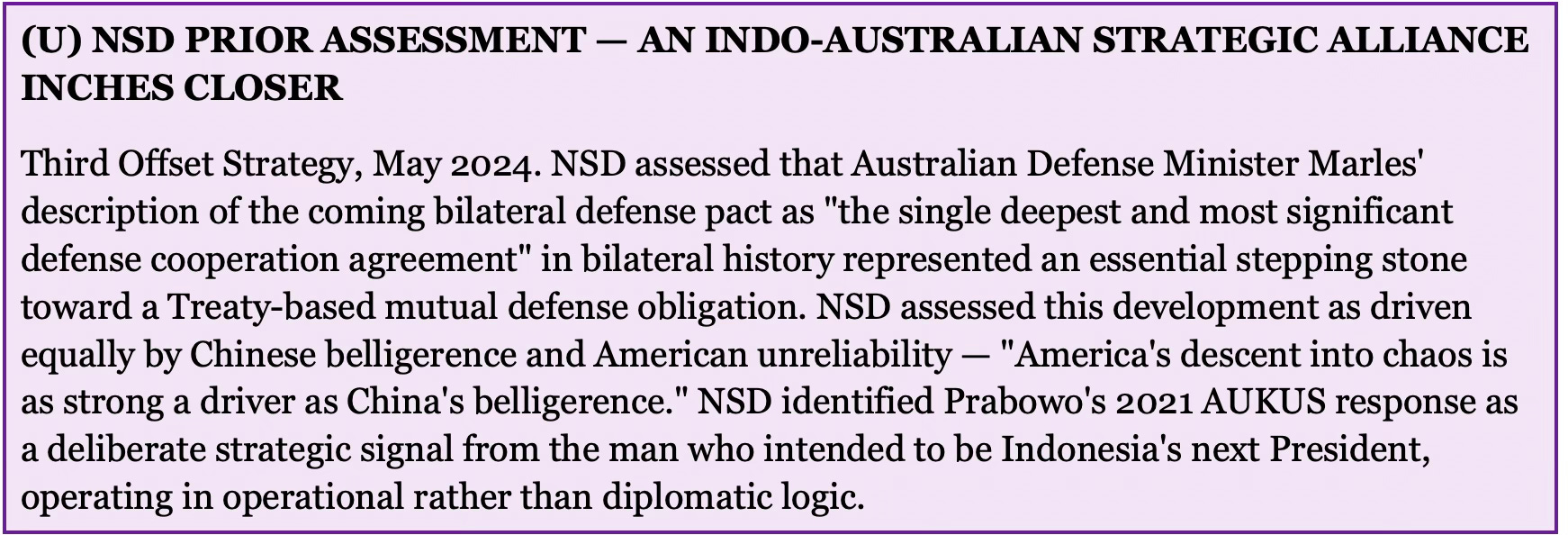
The Prabowo factor is the analytical thread that makes the architecture credible rather than theoretical. When Indonesia’s Defense Minister — now its President — responded to the September 2021 AUKUS announcement not with the diplomatic alarm of his Foreign Ministry colleagues but with the observation that “if they feel threatened they will do whatever they can to protect themselves, and we understand and respect them,” he was not navigating a politically sensitive bilateral issue. He was a former Kopassus special forces commander who had worked through the operational logic of AUKUS to its conclusion in a way that diplomatically-oriented colleagues had not.
His conclusion was strategically correct. The AUKUS submarines are not a threat to Indonesia. They are a forward screen for Indonesia. Any Chinese maritime operation aimed at Australia’s northwest must transit Indonesian archipelagic waters. The moment China forces that transit, Indonesia is in the fight — not by choice, not by treaty, but by geography. The AUKUS submarines operating in the eastern Indian Ocean give Indonesia credible underwater deterrence against Chinese naval projection through its own sovereign waters. Without AUKUS, Indonesia faces Chinese naval pressure in the Natuna Islands with limited subsurface capability to contest it. With AUKUS submarines in the neighborhood, China must account for Virginia-class and eventually Australian SSN capability in every operation it plans through the archipelago. The submarine is an Indonesian defensive asset whether or not a formal agreement names it as such.
This is also why Indonesian F-16s flying in a USSTRATCOM B-52 Bomber Task Force in 2021 was not routine exercise participation. It was a deliberate signal from a government that had been officially non-aligned since the Bandung Conference in 1955. Indonesian fighters in a nuclear deterrence mission — because B-52 Bomber Task Force operations carry that implicit weight — is a statement made in operational language rather than diplomatic language about which direction Indonesia faces when the operational question is concretely framed. The 2024 defense agreement is the direct institutional consequence of that 2021 signal. Both were predictable. NSD predicted both.
The primary strategic function of the AUKUS submarines is not to project power independently into the South China Sea. It is to impose a denial cost on any Chinese attempt to project maritime power through Indonesia’s archipelagic chokepoints toward Australia. A Virginia-class or follow-on SSN armed with long-range Tomahawk stand-off weapons does not need to win a visible fleet engagement; it needs to make every Chinese surface combatant and logistics vessel transiting the archipelago operate under the assumption of undetectable subsurface threat. That cost-exchange ratio — one stealth platform imposing persistent risk on a much larger surface and logistics fleet — is what justifies the AUKUS investment even given its timelines and political overhead. The submarine is a denial weapon. Its strategic value is not the strike it fires but the freedom of maneuver it denies.
The Philippines
The Philippines provides the northern lock on the network’s chokepoint geometry. Control of the Luzon Strait. Direct South China Sea territorial disputes that have moved the Marcos government toward the firmest anti-Chinese alignment Manila has maintained in decades. Basing access extending ISR and strike coverage northward toward the first island chain and the Taiwan contingency. The Philippines occupies ground no Chinese operation of strategic scale can ignore, and its alignment closes the northern approaches in a way no alternative combination can replicate.
Japan
The compounding strategic implication of the five-actor network that Western analysis has understated: collectively, this architecture can choke China’s maritime trade. More than 80% of Chinese oil imports transit the Strait of Malacca, Lombok, and Sunda — all within the operational reach of network members. The South China Sea sea lanes through which Chinese trade moves to global markets pass through waters where Philippines basing and Indonesian chokepoint control can create persistent operational pressure. An architecture that was conceived primarily in defensive terms — denying Chinese power projection toward the network’s southern arc — doubles as an offensive economic instrument that the network’s members have not yet named publicly or coordinated explicitly. That leverage exists regardless of whether it is ever deliberately exercised. Its existence changes the Chinese strategic calculus in ways that the individual capabilities of network members do not.
Japan contributes the economic and military weight that gives the network strategic credibility beyond its immediate geography — and in 2026 is the actor whose strategic evolution is moving fastest and with most consequence for the network’s long-term deterrent architecture.
The Australia-Japan relationship has a depth that predates the current strategic moment. Two advanced economies, technologically sophisticated, with deep trade and investment interdependence built across decades. The complementarity is genuine — Japan’s manufacturing and technology base alongside Australia’s resource and energy supply forms an economic partnership of mutual dependency that has been quietly strategic even when it was formally commercial. The Reciprocal Access Agreement that allows Australian and Japanese forces to operate from each other’s territory is the formal expression of a relationship whose operational logic has been evident for years.
What has changed in 2024 and 2025 is the military dimension. Japan’s acquisition of long-range strike capability — the decision to develop and procure stand-off weapons capable of reaching adversary launch infrastructure, shattering the constitutional constraints maintained for seventy years — is as significant a development in the regional military balance as any since the end of the Cold War. Japan is building the ability to hold Chinese missile launch sites at risk from Japanese sovereign territory. That capability, integrated with Australian ISR and Indonesian geographic depth, gives the network an offensive deterrent reach that no individual member possesses.
And then there is the dimension that is not yet publicly declared but that NSD assesses as the logical and increasingly visible direction of Japanese strategic preparation.
Japan is undertaking, quietly and systematically, the intellectual and industrial groundwork that would be required if a political decision to develop a sovereign nuclear deterrent were ever made. This is not declared policy. It is a reading of the pattern — the same pattern NSD identified across the allied landscape in 2023 — that smart states with eroding extended deterrence coverage make preparations to go it alone before they make the political decision to do so. Japan’s scientific and industrial capability is not in question. Its enrichment capacity is not in question. The political and treaty obstacles are substantial. What is changing is the strategic calculus that underlies the political question.
Japan is not alone in this trajectory. South Korea has been publicly explicit in its nuclear debate in a way that reflects the acute threat geometry of a state that faces North Korean nuclear capability with direct strike range and Chinese nuclear capacity at its doorstep. South Korea will, on NSD’s assessment, be the first allied state to cross the nuclear threshold — driven by a threat environment that leaves less room for the patient, incremental approach that Japan is taking. The ROK’s public debate is not performative. It reflects genuine strategic desperation from a society that has watched Ukraine demonstrate what happens to non-nuclear states that surrender their deterrent under international pressure.
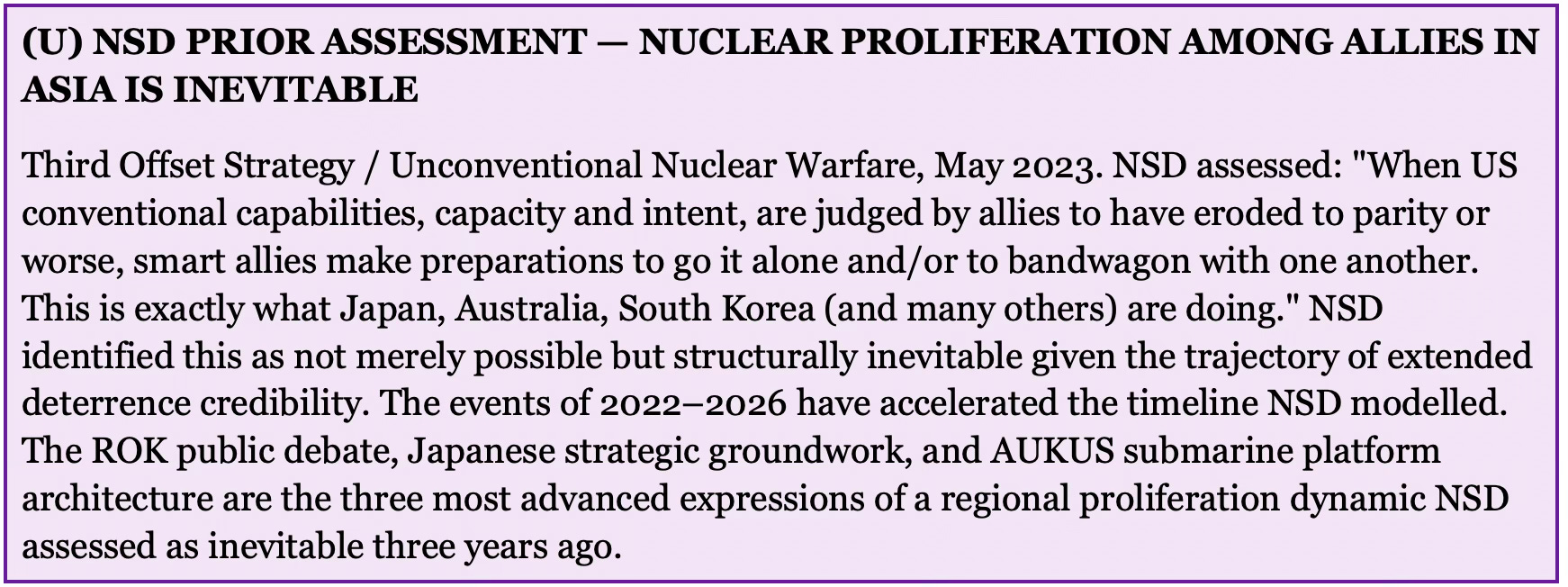
Australia’s position in this sequence is the most structurally prepared and the least publicly acknowledged. It has, through AUKUS, a submarine platform architecture that is precisely what a minimum credible deterrent delivery system requires. It has uranium — the largest identified reserves in the world. It has the scientific and industrial capability. It has a population that has watched two major powers attack non-nuclear states in 2022-2026 and draw the conclusion that international security guarantees are insufficient protection against states willing to bear the cost of conventional aggression. The NPT obligations are real. The political obstacles are substantial. The pathway is neither simple nor short.
NSD’s best estimate of the sequence: South Korea first, driven by the most acute threat geometry and the most explicit public debate. Japan second, driven by the Chinese nuclear build-up and the North Korean capability that South Korean acquisition will make politically irresistible across the Sea of Japan. Australia third — not as an immediate consequence, but as the logical completion of the AUKUS investment’s strategic logic once the regional proliferation dynamic reaches a point where the gap between Australia’s platform capability and its strategic autonomy becomes politically untenable.
NSD does not prescribe this outcome. It names it as the conclusion the evidence is pointing toward — the destination that the trajectory from 2004 to 2026 has been approaching, and that the events of the past four years have made more rather than less analytically compelling.

Singapore
Singapore occupies the role essential to the network’s functionality precisely because it sits formally outside it. The world’s second busiest port. A financial system too deeply integrated into both US and Chinese economic infrastructure for either power to contemplate disrupting. A government that has spent thirty years articulating, with consistent strategic discipline, the position that it will not be forced to choose sides — and that both parties need it too much to force the question. Singapore is the network’s neutral clearing house — the node that keeps economic relationships functioning when political temperature rises between other members. Every serious regional architecture needs such a node. Singapore is the only viable candidate, and its continued neutrality is a feature of the network rather than a weakness.
The geometry of what these five actors collectively control, stated plainly: no Chinese naval operation of strategic scale can enter the Indian Ocean from the Pacific without transiting chokepoints that the Philippines and Indonesia physically control. No Chinese logistics chain can sustain operations against Australian northwest infrastructure without transiting 5,000 kilometers of Indonesian archipelagic territory. No Chinese strike operation against the network’s southern arc can execute without Australian ISR cueing every other member’s response. No Chinese economic coercion of any single member can succeed without disrupting supply chains that Singapore’s financial system and Indonesia’s shipping lanes are essential to. Japan’s long-range strike can reach Chinese launch infrastructure from Japanese sovereign territory. The network does not need to be formally declared because its deterrent logic is inescapable to any serious military planner.
Beijing’s counter-strategy to this architecture is already visible in the pattern of its diplomatic and infrastructure activity across the region. The Solomon Islands security agreement, the facilities arrangement with Kiribati, and sustained economic and legal pressure on Manila are not isolated irritants — they are attempts to prise open the network at its least resilient points. China does not need to defeat the network’s military capabilities head-on if it can convince Indonesia that neutrality is safer than alignment, persuade Pacific Island governments that hosting Chinese logistics and telecommunications infrastructure is cost-free, or reverse the Philippines’ current alignment through economic leverage. Containerised missile and ISR systems positioned in politically contested Pacific spaces would force Australia and its partners to defend a 360-degree threat perimeter rather than a single northwest vector, diluting already scarce ISR, air-defense, and naval resources. The network’s strength is its geographic logic. Its vulnerability is the political resilience of its least committed members. China’s counter-strategy targets both simultaneously.
This is the architecture the 2004 thesis was pointing toward without being able to name it. Indispensability was the deterrence mechanism. The network is the structural framework that makes indispensability operationally credible. The deterrent question is the completion of the logic that makes it durable.
(U) PART VI — THE CLOSER: IRAN’S FREE GIFT AND THE PROOF OF CONCEPT
Iran is not thinking about Australia. It does not need to. The IRBM strike on Diego Garcia on 20 March 2026 accomplished more for the strategic education of every Indo-Pacific planner than any direct action against the region could have achieved — not through anything Iran did to Australia, but through what it demonstrated simultaneously to every capital in the network.
The demonstration had three distinct strategic effects, each compounding the others.
First: fixed logistics infrastructure treated as sanctuary is no longer sanctuary at extended ballistic range. The fuel farms, the Maritime Pre-Positioning Ships, the logistics concentration sustaining US power projection across two combatant commands — demonstrably reachable, under combat conditions, by a degraded arsenal. Every Indo-Pacific planner who watched that track understood instantly what it meant for their own fixed infrastructure. The coordinates are known. The ranges are comparable. The precedent is established under combat conditions.
Second: the intelligence claim that Iran had been reduced to 8% residual missile capability was operationally refuted. Either the assessment was wrong, the methodology was flawed, Iran reconstituted faster than assessed, or the 8% referred to short-range systems while long-range capability survived substantially intact. Any of these conclusions is a serious intelligence or integrity failure.
Third — and most consequential for the Australian picture — the IRBM as a strategic shaping instrument forces ABM resource dispersal across an expanded threat surface in a way that creates direct operational benefit to Iran in its immediate theatre. Every Aegis destroyer repositioned to cover Diego Garcia, every SM-3 expended on an Indian Ocean IRBM track, every THAAD battery that must now model expanded threat coverage — that is capacity removed from the Gulf, from the Hormuz approaches, from the CSG and ARG screen in the waters where the actual fight is being conducted. Iran gains operational relief in its own backyard by threatening someone else’s. The follow-on drone and USV campaign — cheap, proven, available in numbers — can then target the fuel farms and MPS ships on different axes and timelines against defenses now oriented toward the ballistic threat.
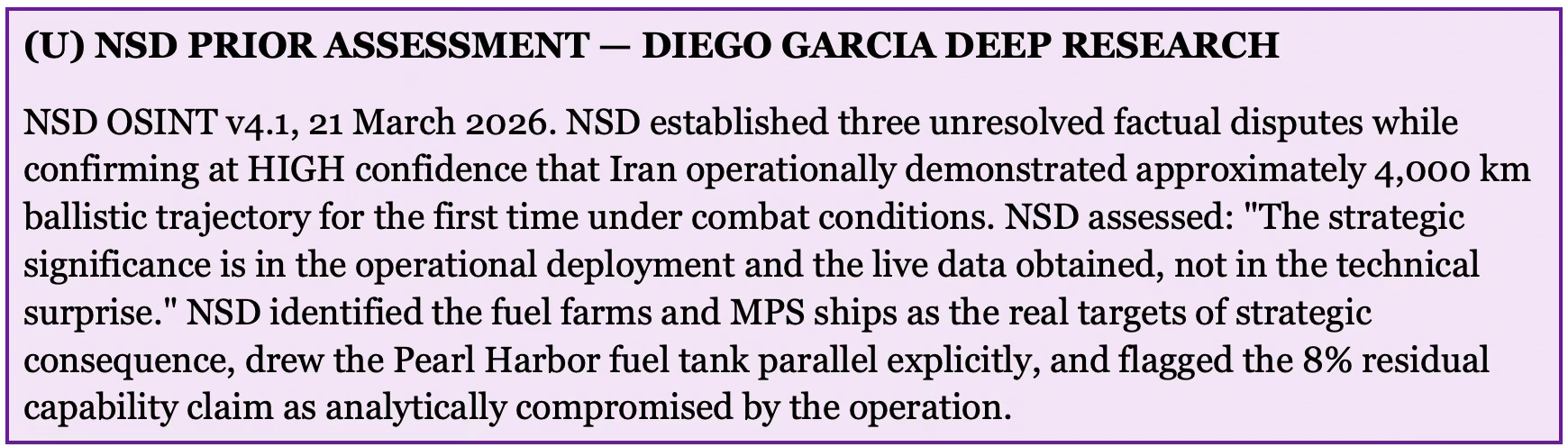
This is the Pearl Harbor lesson in its 2026 form. Japan attacked the battleships and left the fuel. The battleships were obsolete. The 4.5 million barrels of fuel at Pearl Harbor were irreplaceable in the timeframe that mattered. Diego Garcia holds comparable fuel stocks — the logistics beating heart of US naval and air operations across two combatant commands. Without them, carriers cannot sustain operations. B-52s cannot fly persistent campaigns. Iran understood this, and demonstrated it.
Now apply that lesson to the Northwest Shelf. China does not need to destroy the LNG complex to achieve the strategic effect the thesis requires. It needs to demonstrate, in the operational vocabulary that the Diego Garcia strike has now established as legitimate, that it can hold the infrastructure at risk. A single DF-26 test that splashes within the flight envelope of Dampier Archipelago coordinates achieves that demonstration. A containerised system on a Pacific Island — revealed through an intelligence leak rather than a strike — achieves it at closer range and with higher political shock value. The sub-threshold coercion scenario has a live operational template as of 20 March 2026.
Meanwhile, Trump continues to manage Australian estrangement on Iran’s behalf and China’s, at no cost to either. Every tariff. Every diplomatic insult. Every public declaration that allied sovereignty is negotiable. Every war of choice that costs Australian consumers and veteran political goodwill. All of it moves Australian public opinion toward the 44% who already support a more independent foreign policy. Iran’s optimal strategic outcome in the Indo-Pacific is not an Australia that has been attacked. It is an Australia that remains estranged from Washington, unavailable for coalition operations, while its soil hosts the infrastructure that US operations depend on. The current US President is delivering that outcome as a matter of daily policy.
The 2026 “no” will not be the last. That is the proof of concept the moment has established. Australia proved that a formal ally can decline a US war, absorb the diplomatic consequences, maintain the formal alliance architecture, and survive politically. Once demonstrated, that template is available to every ally watching. The next refusal — from a different partner, in a different conflict — will be easier to execute because the precedent exists.
What Australia proved in 2026 is not that it has abandoned America. It proved that it can make independent sovereign decisions. That is precisely what the NSD analysis of the early 2000s was calling for, in a different register, before the world had lived through enough to understand what it was describing.
The architecture that makes Australian sovereign strategic decision-making viable — indispensability plus the network geometry of impregnability — has been assembling itself for twenty-two years. It has been assembling because the strategic logic is inescapable, because Chinese overreach has created the convergent interests that make coordination rational, and because American unreliability has made the resilience necessary.
The anticipatory intelligence record is now sufficiently confirmed that the conclusion can be stated with the confidence the evidence has earned. The destination the early NSD analysis was pointing toward is not a distant theoretical future. It is the strategic reality being built, negotiated, and operationally confirmed in 2026. The question that remains open — the one that the full arc from 2004 to 2026 points toward but that political and treaty obstacles have not yet resolved — is whether the architecture being built will ultimately include the one capability that makes strategic autonomy durable rather than aspirational.
That question is not NSD’s to answer. It is Australia’s, and Japan’s, and South Korea’s. But the events of the past four years have made it considerably harder to avoid asking — and the sequence in which it will be answered, NSD assesses, is already becoming visible.
What is already visible — and what the commentary has almost entirely missed — is the reframing of Australia’s strategic identity that the 2026 “no” makes explicit. Australia is no longer simply a defended ally holding valuable real estate. It is a regional strike hub: the ISR node that sees the theatre, the logistics base that sustains forward operations, the submarine platform that denies chokepoint transit, the resource base that both great powers cannot afford to lose, and the political actor that has now demonstrated the will to exercise sovereign judgement about when and whether to fight, independent of Washington’s preferences. The transition from defended ally to regional strike hub is the strategic transformation that the 2026 “no” announces. Whether Canberra fully understands what it has become is a separate question. Whether Beijing and Washington understand it is the most consequential question in the Indo-Pacific.
“The transition from defended ally to regional strike hub is the strategic transformation that the 2026 “no” announces.” — NSD, 23 March 2026
ANNEX A - AUSTRALIA’S STRATEGIC ASSET INVENTORY
ANNEX B - AUSTRALIA’S STRATEGIC WEIGHT
ARE BOTH BELOW
(U) SOURCES AND ATTRIBUTION
(U) This assessment is based exclusively on open-source reporting, confirmed public statements, and synthesized analytical judgment. It does not reflect classified intelligence. All speculative conclusions are clearly marked as such. NSD maintains Chatham House rules on all operational sourcing.
— NSD —
Military Innovation Lab · National Security Desk · CW2-2026-005
UNCLASSIFIED // OSA // ANTINT
The National Security Desk offers these posts freely, but your support is necessary and appreciated. Please subscribe, paid if you’re able, or leave a tip.
Thank you

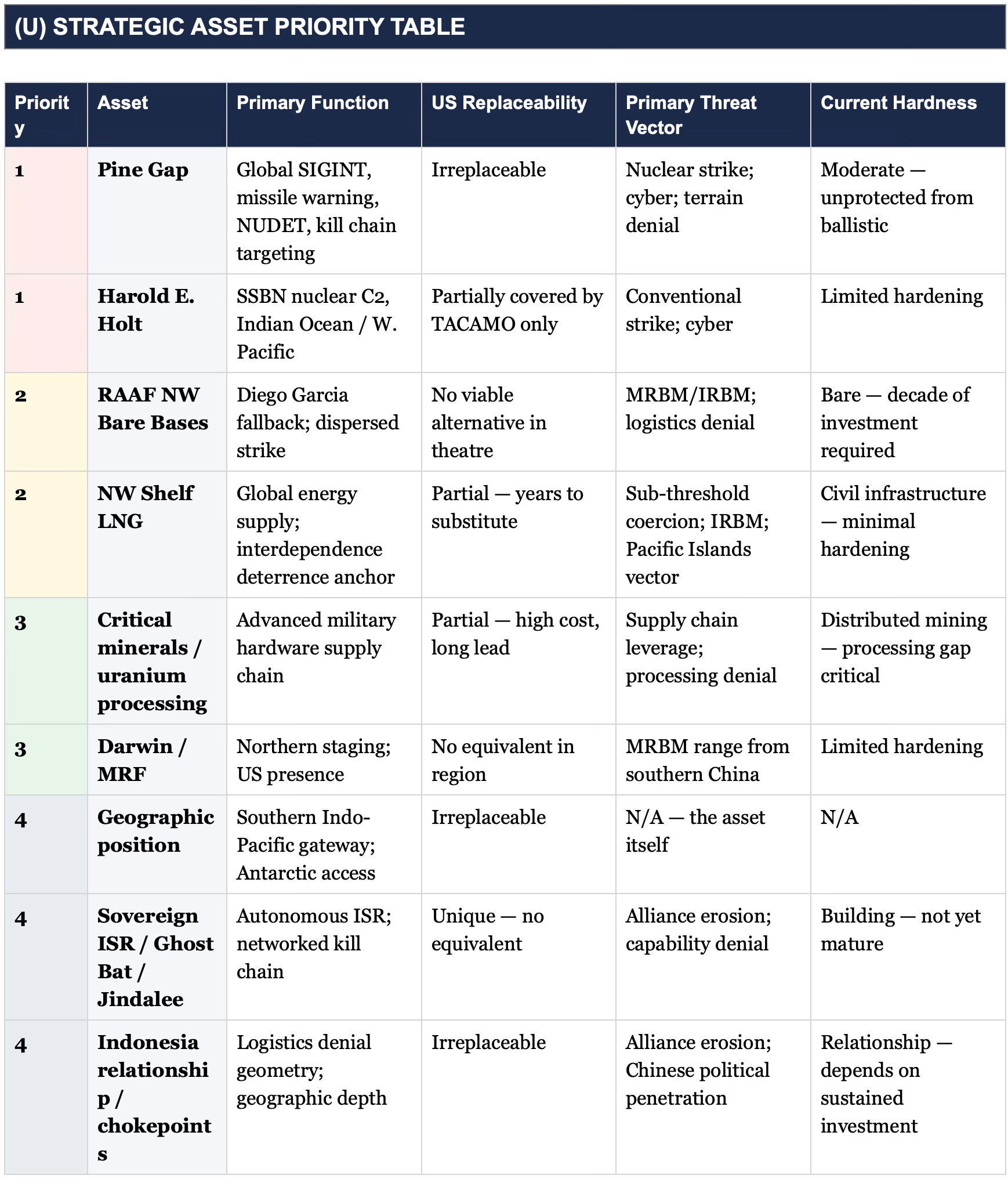
ANNEX A Australia’s Strategic Asset Inventory
Narrative Assessment: Priority Order by Strategic Consequence
Assets are ordered by the actual operational consequence of their loss or denial to US and allied capability — not by size, cost, or political salience. Irreplaceability matters more than scale. Operational effect matters more than symbolic significance.
(U) PRIORITY ONE — OPERATIONALLY CATASTROPHIC
Priority One — Operationally catastrophic, unrecoverable in any relevant timeframe
Pine Gap Joint Defense Facility stands alone in this category. No combination of alternative collection platforms can replicate its geosynchronous SIGINT coverage, ballistic missile early warning, NUDET monitoring, and kill chain targeting data for the eastern hemisphere. Its data feeds into nuclear release authority decision cycles. The 1974 assessment — “damned near irreplaceable” — understated the case as of 2026. Fifty years of operational deepening have made it foundational rather than merely important. Its loss is a category change, not a degradation — comparable to the loss of GPS to precision strike. An adversary that denies US access to Pine Gap without destroying it has achieved a strategic intelligence victory of the first order. Located 940 miles from Darwin on a single-lane road in the outback, it simultaneously presents the most irreplaceable allied intelligence asset in the eastern hemisphere and a prime nuclear targeting opportunity with negligible collateral damage potential.
Harold E. Holt Naval Communication Station belongs in Priority One because of its nuclear C2 function. SSBN communications across the Indian Ocean and western Pacific is not a convenience — it is the structural requirement of nuclear deterrence credibility in the southern hemisphere. TACAMO provides airborne backup. It does not provide the persistent, high-reliability, fixed-site capability the nuclear posture requires at scale. A deterrence gap in SSBN communications is a gap adversaries eventually probe.
(U) PRIORITY TWO — SEVERELY OPERATIONALLY DAMAGING
Priority Two — Severely operationally damaging, recovery measured in years
The RAAF northwestern bare base network — Learmonth, Curtin, Scherger, Tindal — is the Diego Garcia fallback that exists nowhere else in the Indian Ocean region not simultaneously within Chinese or Iranian conventional strike range. Current capability is dramatically insufficient for the load a denied or degraded Diego Garcia would impose. The gap between current capability and operational requirement — hardened shelters, protected buried fuel storage, maritime resupply infrastructure, dispersed ammunition pre-positioning, hardened communications — represents a decade-long investment program that has not begun at the required scale. The investment case became strategically urgent on 20 March 2026.
The Northwest Shelf LNG complex — Gorgon, Wheatstone, North West Shelf, Prelude — producing approximately 10% of global LNG supply from known-coordinate coastal infrastructure. The anchor of Australian economic indispensability to both great powers. Unprotected against sub-threshold coercion. Its credible threatened disruption — without physical attack — changes every insurance premium, investment decision, and offtake negotiation connected to it.
(U) PRIORITY THREE — SIGNIFICANT OPERATIONAL VALUE
Priority Three — Significant operational value, partial substitution possible at high cost over years
Critical minerals and uranium processing capacity. Australia holds significant rare earth reserves and produces a meaningful share of global mine output; the world’s largest uranium reserves; top-three lithium and cobalt. The rare earth processing gap — China processes 85 to 90% of global output including the majority of Australian ore — is the most consequential supply chain vulnerability in the Western defense industrial base. Building Australian in-country processing capacity is a direct counter to the primary Chinese leverage point over Western military production. Without it, the resource indispensability argument has a structural weakness: Australia supplies the raw material while China controls the processed output.
Darwin and the Marine Rotational Force. Northern staging base for US regional presence. Within Chinese MRBM range from southern Chinese sites. Currently underprotected relative to strategic significance. Loss or denial removes the northernmost US military foothold in the Australian theatre.
(U) PRIORITY FOUR — STRATEGIC NETWORK VALUE
Priority Four — Strategic network value, loss degrades but does not destroy network function
Geographic position as the southern Indo-Pacific gateway. Controls the southern approaches between the Indian and Pacific Oceans. Antarctic gateway. Southern ocean access. Cannot be purchased, constructed, or substituted. The reason every asset in this inventory exists in Australia and why none can be relocated.
Sovereign ISR and autonomous systems capability. Ghost Bat loyal wingman. Jindalee OTH radar. MQ-4C Triton. A growing defense industrial base oriented toward autonomous systems and networked kill chain capability. A small, educated, technically sophisticated population building sovereign capability in exactly the domains that will define future conflict.
The Indonesia relationship as operational architecture. The bilateral defense agreement and operational complementarity that makes the northwest’s geographic depth viable as a defensive concept. Not a physical asset but an operational relationship whose loss would remove the geographic depth that makes Australian northwest defense sustainable. The most asymmetrically powerful element of Australian security that costs the least to maintain and that Washington has done the most, through its “attack the allies” diplomacy, to inadvertently strengthen.
Assessment valid as of 23 March 2026. Mandatory re-evaluation triggers: formal Australian parliamentary debate on alliance terms; Indonesian bilateral treaty elevation to mutual defense obligation; Chinese ballistic missile demonstration within Northwest Shelf flight envelope; ROK nuclear declaration; AUKUS submarine program schedule change; Diego Garcia fuel farm reconstruction completion announced.
ANNEX B Australia’s Strategic Weight

Resources, Economy, and the Defense Industrial Base That Makes the Network Real
In this assessment, the strategic significance of Australia in the Indo-Pacific architecture NSD has documented is not primarily military. It is material. Australia sits on the resource base that both great powers need to build, power, and sustain the advanced military and economic systems that will determine the outcome of the competition between them. Understanding that resource base — what Australia holds, what it currently exports, what processing capacity exists in-country, and where the critical gaps are — is essential to understanding why the “no” of 2026 matters so much more than any individual basing arrangement.
This assessment maps that material foundation, prioritised by strategic consequence.
(U) I. ENERGY EXPORTS: THE FIRST PILLAR OF INDISPENSABILITY
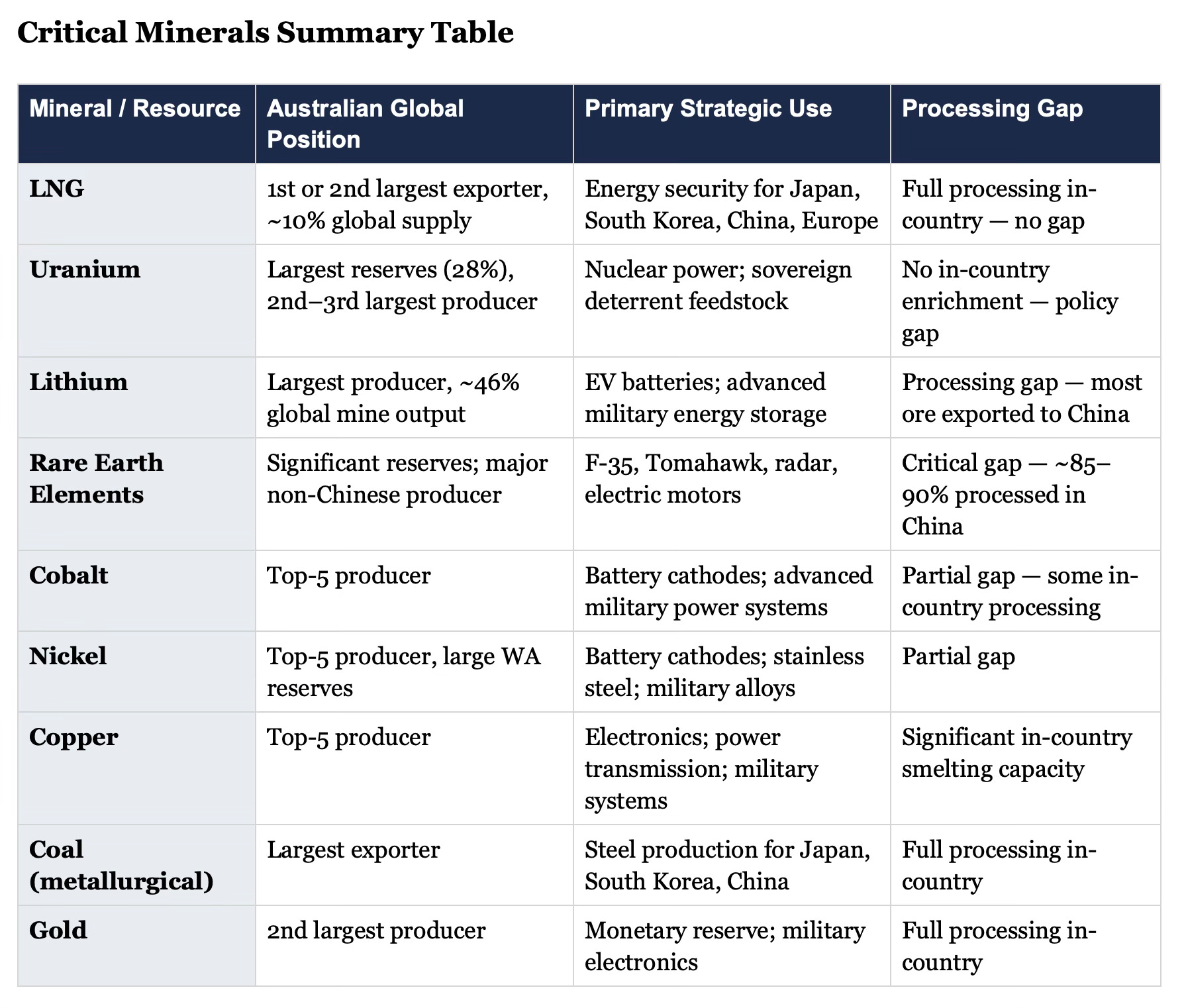
Australia is one of the world’s top LNG exporters, typically ranking second or third globally behind the US and Qatar, with around one-fifth of global LNG exports in recent years (IEA, 2025; IEEFA, 2025). The northwest Shelf, Gorgon, Wheatstone, and Prelude facilities — concentrated in the Dampier Archipelago and broader Northwest Shelf region of Western Australia — represent one of the world’s most significant LNG export complexes.
The customer base is strategically distributed in a way that creates the interdependence deterrence architecture NSD has described. China and Japan are Australia’s two largest LNG customers, each taking roughly one-third of exports in recent years, followed by South Korea at around 15% (IEEFA, 2025; Geoscience Australia, 2024). Together, three of the four most significant US allies and strategic partners in the Indo-Pacific — and the primary US strategic competitor — depend on Australian LNG supply for a significant proportion of their energy security. Disrupting Australian LNG supply would significantly affect both sides of the US-China competition simultaneously, albeit in different ways.
The more consequential point for planners in Tokyo, Seoul, Canberra, and Washington is that this interdependence can be designed into a deterrence architecture rather than left as a market accident. A concentration of Japanese, Korean, Chinese, and increasingly European dependence on Australian LNG gives Canberra latent leverage over both sides of the great-power rivalry that no other US ally holds. Exercised crudely, that leverage would trigger rapid diversification and long-term erosion of Australia’s position. Used subtly, it allows Australia to hard-wire its own security into the energy requirements of every major actor: no one can punish Canberra without also imposing visible costs on their own industrial base. The Australian debate has barely begun to treat this as a deliberate instrument of statecraft rather than a commercial exposure, and US defense planning still tends to treat LNG infrastructure as a target set rather than a mutually-owned stability mechanism.
The Northwest Shelf infrastructure is the concentration vulnerability NSD has identified as the Australian equivalent of the Diego Garcia fuel farms: fixed coordinates, known, economically critical, and currently protected by commercial rather than military hardening standards. The Gorgon processing facility on Barrow Island and the Dampier export terminal are the decisive nodes. Their disruption — not destruction, merely demonstrated vulnerability — would ripple through the global LNG market in ways comparable to the Ras Laffan strike that preceded the Diego Garcia IRBM event.
Uranium
Australia holds the world’s largest identified uranium reserves — around 1.7 million tonnes, or roughly one-quarter to one-third of identified global recoverable uranium resources as of 2024 (Geoscience Australia, 2024; USGS, 2025). It is currently the second or third largest producer globally, after Kazakhstan and competing with Canada depending on year.
The strategic significance of Australian uranium has two distinct dimensions. The civilian dimension — nuclear power generation fuel for allied nations pursuing decarbonisation without dependence on Russian or Chinese uranium supply — is growing in importance as European and Asian nations expand nuclear capacity. The military dimension — enriched uranium as the fissile material for nuclear weapons programs — is the dimension that the NSD nuclear proliferation assessment named as the foundation for Australian sovereign deterrent capacity should the political decision ever be made. Australia does not currently enrich uranium. It mines and exports yellowcake. The enrichment gap is primarily the result of policy choices rather than underlying resource or industrial constraints (Geoscience Australia, 2024).
Treating uranium purely as a civil export commodity understates the latent coercive power it gives Canberra if the US security guarantee visibly frays. An Australia that decided to close the enrichment gap could move from non-nuclear status to a credible latent deterrent far faster than most publics, and perhaps most US officials, appreciate. The combination of high-quality ore, existing fuel-cycle expertise, alliance access to technology, and an emerging fleet of nuclear-powered submarines creates a pathway to a minimum deterrent whose delivery systems would be difficult to track or pre-empt. NSD does not prescribe this outcome. Leaving it entirely unspoken, however, also leaves Washington free to discount the possibility that Canberra might one day choose to exercise it.
Australian uranium production is currently dominated by the Olympic Dam mine in South Australia — a BHP operation that is also one of the world’s largest copper deposits and a significant gold and silver producer. Olympic Dam’s multi-mineral profile makes Australian uranium supply chains more resilient than single-commodity operations.
Coal and LPG
Australia is among the world’s largest coal exporters and is generally the leading exporter of metallurgical coal by volume — the coking coal essential to steel production — representing a particularly strategic export. Japanese and South Korean steel industries are structurally dependent on Australian metallurgical coal. Chinese steel production draws significantly from Australian supply despite the trade friction of 2020 to 2022 that resulted in unofficial Chinese bans subsequently reversed as domestic steel demand required it. The reversal itself was instructive: Chinese economic need overrode political preference. This is the interdependence mechanism operating in practice.
(U) II. CRITICAL MINERALS: THE SECOND AND GROWING PILLAR
Critical minerals have emerged as the second dimension of Australian strategic indispensability that the 2004 thesis could not fully anticipate. The competition between the US and China has moved decisively into the technology domain — semiconductors, advanced batteries, electric vehicles, precision guidance systems, satellite platforms, and next-generation military hardware — and every one of these domains depends on a specific set of minerals that are neither evenly distributed nor easily substituted.
Lithium
Australia is the world’s largest lithium producer, accounting for approximately 46% of global mine production. The Pilbara region of Western Australia hosts the world’s largest hard-rock lithium operations — Greenbushes, Pilgangoora, and Mt Marion — with production expanding rapidly in response to electric vehicle and grid-scale battery demand. Lithium-ion batteries are the energy storage technology for both the clean energy transition and the advanced military systems — electric propulsion, directed energy weapons, autonomous platforms — that will characterise next-generation warfare.
The processing gap is significant. Australia mines lithium spodumene ore but currently exports most of it to China for processing into lithium hydroxide or lithium carbonate before it enters battery supply chains. Australian in-country lithium hydroxide processing capacity is growing — Albemarle’s Kemerton facility in Western Australia is the largest, with others under construction — but the majority of value-add still occurs in China. Closing this gap is both an economic opportunity and a direct national security requirement: reducing Chinese processing leverage over the battery supply chains that underpin Western military and industrial capability.
Rare Earth Elements
Australia holds significant rare earth reserves and is among the world’s largest producers outside China. Rare earths — the group of seventeen elements including neodymium, praseodymium, dysprosium, and terbium — are irreplaceable in permanent magnets used in F-35 avionics, Tomahawk guidance systems, radar systems, electric motors, and wind turbines. There are currently no widely adopted substitutes at comparable performance and cost for many industrial and defense applications.
The processing vulnerability is more acute for rare earths than for any other critical mineral. China processes approximately 85 to 90% of global rare earth output, including the majority of Australian ore. Australian rare earths mined at Mt Weld in Western Australia — operated by Lynas Rare Earths, the world’s largest non-Chinese rare earth producer — have historically been shipped to the Lynas Advanced Materials Plant in Kuantan, Malaysia for initial processing before final separation. Lynas is now building processing capacity in Kalgoorlie, Western Australia, reducing but not yet eliminating the Malaysian processing dependency. Full Australian in-country rare earth separation capacity — producing the separated oxides that feed directly into magnet manufacturing — remains a strategic gap whose closure is a direct US national security interest, as acknowledged by the October 2025 Trump-Albanese critical minerals agreement.
The F-35 example is the most direct illustration of the vulnerability: an aircraft that is the backbone of US and allied air power depends on rare earth permanent magnets in its avionics and propulsion systems. Those magnets depend on Chinese-processed rare earth inputs. An Australia that builds full-cycle rare earth processing — from mine to separated oxide to magnet-grade material — removes that dependency from the Western defense industrial base. Few non-Chinese producers are as well positioned as Australia to do this at meaningful scale.
For Asian air forces betting their future on F-35 and similar fifth-generation platforms, this supply-chain reality should be treated as an operational risk, not just an industrial one. A crisis in which Beijing quietly slows or selectively restricts rare earth oxide exports would not immediately ground allied fleets, but it would begin a countdown on maintenance cycles and upgrade paths that current contingency plans barely acknowledge. An Australian-anchored, non-Chinese rare earth processing chain does not remove the vulnerability overnight, yet it gives regional operators a clear pathway to insulating their most sophisticated platforms from future coercive squeezes. From Tokyo and Seoul’s perspective, co-financing Australian processing capacity is therefore not an industrial subsidy; it is an affordable insurance premium on the continuity of their own airpower.
Cobalt, Nickel, and Other Battery Minerals
Australia is a significant producer of cobalt — a by-product of nickel mining — and holds substantial nickel reserves in Western Australia. Nickel-cobalt chemistry underpins the high-energy-density battery cathodes used in electric vehicles and advanced military power systems. The Ravensthorpe and Murrin Murrin nickel-cobalt operations in Western Australia, and the emerging Kalgoorlie battery materials precursor industry, position Australia as a significant participant in the battery supply chain architecture that both the clean energy transition and next-generation military systems depend on.
Copper and Gold
Australia is a top-five global copper producer — Olympic Dam alone is one of the world’s largest copper ore bodies — and the world’s second largest gold producer. Copper is the irreplaceable conductor of the electrification economy and of military electronics at every scale from circuit boards to power transmission infrastructure. Gold: Australia ranks among the world’s top two or three gold producers depending on year, alternating with Russia and China (USGS, 2025). Gold remains a monetary reserve asset and has specific military electronics applications.
(U) III. ECONOMIC WEIGHT: THE CONTEXT
Australia’s economy is consistently ranked between the 13th and 16th largest economy globally by nominal GDP, depending on year and measure (World Bank, 2024; IMF, 2024). At purchasing power parity it ranks somewhat higher. It is a high-income, diversified, services-dominated economy with a strong resource export sector that punches above its weight in international commodity markets relative to its overall economic size.
Several dimensions of this economic profile are directly relevant to strategic assessment.
Population density and geography create an inherent tension between economic weight and military capacity that shapes every Australian strategic debate. Around 26 million people as of the mid-2020s (ABS, 2024) spread across a continent of 7.7 million square kilometers — the sixth largest country by area — means that the ratio of people to territory is among the lowest of any developed nation. Conventional military forces sufficient to defend that geography against a peer competitor would require a defense budget and force structure that the population base cannot easily sustain. This is the structural driver of Australian interest in asymmetric deterrence, ISR-heavy force design, and alliance relationships: the country’s geography demands security arrangements it cannot provide entirely through its own conventional military capacity.
Trade exposure to China is the defining economic vulnerability. China is Australia’s largest trading partner by significant margin, accounting for around one-third of Australian exports and roughly one-fifth of imports in recent years, depending on year and measure (ABS, 2024; DFAT, 2024). Iron ore, coal, LNG, and agricultural products dominate the export profile. The 2020 to 2022 Chinese trade coercion episode — in which China imposed unofficial bans on Australian coal, barley, wine, beef, cotton, timber, and lobsters in response to Australia’s call for a COVID-19 origins investigation — demonstrated both the vulnerability and the resilience. The vulnerability: Australia was exposed to significant economic pressure from Chinese trade retaliation. The resilience: Australian exports largely found alternative markets, China eventually reversed most of the restrictions as its own import needs reasserted economic logic, and Australia did not capitulate on the underlying policy position. The episode confirmed that interdependence cuts both ways — and that Chinese economic coercion has limits when the target commodity is genuinely difficult to replace.
For medium-sized Asian economies watching that episode, the Australian experience is an existence proof that selective diversification and alliance signalling can blunt Beijing’s coercive leverage without requiring full decoupling. Canberra paid real sectoral costs, but demonstrated that bulk commodities with few substitutes — iron ore, high-grade coal, niche agricultural products — are hard for China to replace at scale and speed. That lesson travels. Indonesia on nickel, Malaysia on semiconductors, and Vietnam on manufacturing niches can design their own hard-to-replace profiles, using Australia’s path as a template. In that sense, Beijing’s failed coercion attempt unintentionally strengthened the bargaining position not only of Canberra but of a wider ring of states that have watched carefully how much punishment the Chinese economy is actually willing to inflict on itself to make a point.
In NSD’s analytical framework, the Trump-Albanese critical minerals agreement of October 2025 — a bilateral framework committing both countries to a combined investment of approximately USD 8.5 billion in critical minerals projects — represents Washington’s belated recognition that Australian resource access is a strategic dependency, not a commercial preference. The agreement explicitly targeted Chinese dominance of critical mineral supply chains and established processing capacity development as a shared priority. Its timing — occurring simultaneously with Trump’s public contempt for Australian leadership and his imposition of tariffs on Australian exports — illustrated the incoherence at the heart of the current US-Australian relationship: Washington understands the strategic value of Australian resources while failing to understand the strategic value of the Australian relationship.
(U) IV. Defense INDUSTRY: THE INNOVATION EDGE
Australia’s defense industry is not large by global standards. It is not attempting to be. It is building sovereign capability in precisely the domains that will determine the character of future conflict, with a strategic clarity that larger defense industries with more established production lines have often struggled to maintain.
Ghost Bat and Loyal Wingman
The Boeing Australia MQ-28A Ghost Bat is arguably the most strategically significant defense industrial product Australia has produced. A collaborative combat aircraft — an uncrewed autonomous wingman designed to extend the reach, persistence, and survivability of crewed fifth-generation aircraft — the Ghost Bat was designed and built in Australia using Australian systems integration capability. It is one of the first loyal wingman aircraft to fly at scale and the leading operationally focused program in this category, with Australia a leading early mover in this development.
The operational concept the Ghost Bat represents — attritable autonomous platforms that can be risked in high-threat environments where crewed aircraft cannot, extending the sensor reach and strike capacity of the human pilot while absorbing attrition — is the direction military aviation is moving globally. Australia led this development. The Ghost Bat program gives Australian defense industry a position at the forefront of the autonomous combat systems domain that is genuinely ahead of where most analysis locates it.
Jindalee Over-The-Horizon Radar Network
The Jindalee Operational Radar Network — a chain of over-the-horizon backscatter radar installations across northern Australia — is, under the right ionospheric conditions, capable of detecting aircraft taking off from Beijing. JORN bounces high-frequency signals off the ionosphere to achieve detection ranges of roughly 1,000 to 3,000 kilometers, covering millions of square kilometers of ocean and land in a single sweep. No other US ally operates a sovereign ground-based ISR architecture of comparable reach. For a country of 26 million people, it is a genuinely extraordinary strategic asset (Australian Government Department of Defense, 2023).
The strategic significance of JORN to the network architecture NSD has described is substantial. It means Australian ISR is not dependent on satellite coverage or forward-deployed sensors to see what is approaching across the Indian Ocean and through the archipelagic approaches from the north. It provides the persistent, sovereign, ground-based radar coverage that gives the network its eyes at range — cueing the response of Indonesian, Philippine, Japanese, and US assets to threats that Australian sensors have identified first. In the contested electromagnetic environment that a serious Chinese operation would generate, JORN’s ground-based over-the-horizon architecture is significantly more survivable than satellite-dependent ISR.
The sovereign character of this ISR architecture matters as much as its technical range. In every major crisis, whoever owns the sensor picture owns the political narrative about who moved first, who escalated, and who crossed which line. An Australia that can publish or selectively share its own JORN- and Triton-derived data is harder to gaslight by either ally or adversary, and less dependent on US intelligence declassification for domestic legitimacy. That creates subtle but real friction: Washington’s instinct is to treat ISR feeds as alliance property to be rationed; Canberra’s emerging instinct is to treat them as national capital that can be used to build coalitions and shape regional opinion. For Asian partners wary of over-reliance on any single great power, an independent Australian sensor voice is therefore a stabilising asset.
ISR and Unmanned Systems
Australia has invested in and locally developed a range of ISR and unmanned systems capabilities that position it as a serious contributor to the network’s intelligence architecture. The acquisition of MQ-4C Triton maritime surveillance aircraft — the naval variant of the Global Hawk, providing persistent wide-area maritime surveillance across the Indo-Pacific approaches — extends Australian ISR coverage into the oceanic approaches that JORN cannot fully cover. The combination of JORN for land and surface approach surveillance and Triton for oceanic coverage provides a layered ISR architecture that can see approaching threats at ranges that provide genuine decision-making time.
Australian investment in electronic warfare capability — including the EA-18G Growler electronic attack aircraft, operated exclusively by Australia outside the United States in the region — provides a sovereign EW capability that is directly relevant to the contested electromagnetic environment that characterises peer-competitor conflict. The ability to degrade adversary radar, communications, and sensor systems is an asymmetric capability that amplifies the effectiveness of every other platform in the network.
Naval Shipbuilding and AUKUS
Australian naval shipbuilding has historically been a program management challenge rather than a capability success. The Hunter-class frigate program has experienced delays and cost growth that have attracted significant criticism. The AUKUS submarine program — which will eventually see Australia operating nuclear-powered submarines, initially US Virginia-class boats and subsequently an SSN-AUKUS design developed jointly with the UK — represents a generational step change in Australian undersea capability that dwarfs any previous naval acquisition.
The AUKUS submarine is not merely a weapons platform. It is the delivery system for the network’s most consequential deterrent capability. Tomahawk Block V land-attack missiles — typically described in open sources as having a range on the order of 1,600 kilometers — are expected to be among the long-range strike options for AUKUS-enabled undersea platforms, providing the network with a credible deep-strike option against targets across the Indo-Pacific theatre. The platform architecture — a nuclear-powered submarine designed to operate for extended periods at strategic distances without the logistical constraints of conventional submarines — is precisely what a minimum credible deterrent delivery system would require if the political decision were ever made. NSD does not prescribe that outcome. It notes that Australia will have the platform before it has resolved the political question.
Seen from Beijing, a fleet of Australian-crewed, US- and UK-designed nuclear submarines operating from the Indian Ocean and Western Pacific blurs the line between alliance asset and independent actor. The same hull that can launch conventional long-range missiles against PLA bases can, in a different political future, host a sovereign Australian nuclear capability that no US administration could fully control. That dual-use quality cuts both ways. It makes AUKUS boats disproportionately valuable to US Indo-Pacific strategy today. It also gives Canberra a bargaining chip in any future dispute with Washington: the implied threat that if treated as expendable, Australia could choose to re-optimise the force for its own deterrent priorities.
Missiles and Munitions
Australia’s announcement of domestic guided weapons and explosive ordnance manufacturing — the Guided Weapons and Explosive Ordnance enterprise, targeting production of Evolved Sea Sparrow Missiles, HIMARS rockets, and eventually longer-range strike munitions on Australian soil — addresses the most acute operational vulnerability the Ukraine and Middle East conflicts have exposed: munitions stockpiles are finite, supply chains are long, and allies under fire consume weapons faster than peaceful-era production lines can replace them. Building sovereign Australian manufacturing capacity for precision-guided munitions is both a national resilience measure and a contribution to the network’s collective magazine depth.
The AUKUS Pillar II advanced capabilities dimension — covering AI, quantum technologies, cyber, hypersonic weapons, and electronic warfare — positions Australian defense industry as a co-developer, not merely a recipient, of the advanced military technologies that will define future conflict. AUKUS Pillar II memoranda and program announcements emphasise expanded joint R&D access; Australian universities and defense technology companies are now embedded in research programs that would not have been accessible under the previous bilateral relationship framework (Australian Government Department of Defense, 2023).
(U) V. THE STRATEGIC WEIGHT IN SUMMARY
Australia’s strategic weight in the Indo-Pacific is not a function of its military size. It is a function of the combination of what it sits on, what it can see, and what it is building.
It sits on the largest identified uranium reserves in the world and significant rare earth reserves. It produces approximately 10% of global LNG, 46% of global lithium, and is a top-five or top-three producer of cobalt, nickel, copper, and metallurgical coal. These are not peripheral commodities. They are the material inputs of the technology competition that will determine the character of great power rivalry for the next fifty years. Both great powers need them. Neither can easily replace them.
It can see the approaches to the Indo-Pacific through a sovereign, ground-based ISR architecture — JORN, Triton, EA-18G, Pine Gap — that provides persistent coverage at ranges that give the network genuine strategic warning time. It is building the autonomous combat systems — Ghost Bat, the unmanned systems pipeline, the AUKUS submarine platform — that will define how advanced militaries fight in the next generation.
And it is doing all of this with a population of around 26 million as of the mid-2020s (ABS, 2024) — smaller than the greater metropolitan areas of either great power’s capital cities — that ranks near the top of OECD measures for tertiary education attainment and per-capita GDP (OECD, 2024; World Bank, 2024). The tyranny of small numbers that has historically constrained Australian conventional military capacity is being reframed by a strategic investment in the domains where quality and technology matter more than mass: ISR, autonomous systems, undersea warfare, electronic warfare, and the resource supply chains that underpin everyone else’s military production.
The 2026 “no” is not the act of a small country punching above its weight in a moment of political crisis. It is the act of a country that holds cards no one else holds, that has been building the capability to play them independently, and that has finally been given sufficient provocation — by the ally it was defending, not the adversary it was deterring — to use them.
That is Australia’s strategic weight. It is considerable. Washington should understand it before it loses it.
The National Security Desk offers these posts freely, but your support is necessary and appreciated. Please subscribe, paid if you’re able, or leave a tip.
Thank you
(U) REFERENCES
NO
Fraser, M., & Roberts, C. (2014). Dangerous allies. Melbourne University Press.
IEA. (2025). LNG market outlook and trade flows 2025. International Energy Agency. https://iea.org
Lowy Institute. (2025). Lowy Institute Poll 2025: Understanding Australian attitudes to the world. https://poll.lowyinstitute.org/files/lowyinsitutepoll-2025.pdf
National Security Desk. (2023, May 18). Nuclear proliferation among allies in Asia is inevitable. The Third Offset Strategy. https://thirdoffset.substack.com/p/nuclear-proliferation-among-allies
National Security Desk. (2023). Strategic warning threshold crossed. The Third Offset Strategy. https://thirdoffset.substack.com
National Security Desk. (2024, May 15). An Indo-Australian strategic alliance inches closer. The Third Offset Strategy. https://thirdoffset.substack.com/p/an-indo-australian-strategic-alliance
National Security Desk. (2026, February 9). UK, Germany rebrand US as “enemy”. Civil War II. https://civilwarii.substack.com/p/uk-germany-rebrand-us-as-enemy
National Security Desk. (2026, March 5). The two bases America can’t afford to lose. Civil War II. https://civilwarii.substack.com/p/the-two-bases-america-cant-afford
National Security Desk. (2026, March 9). America’s nuclear abandonment of Europe. Unconventional Nuclear Warfare. https://nukes.substack.com/p/americas-nuclear-abandonment-of-europe
National Security Desk. (2026, March 21). NSD OSINT v4.1: Diego Garcia deep research. NSD Internal Assessment.
South China Morning Post. (2021). Paul Keating criticises AUKUS deal. South China Morning Post. https://scmp.com
United States Studies Centre. (2014). Gough Whitlam’s Pine Gap problem. University of Sydney. https://ussc.edu.au/gough-whitlams-pine-gap-problem
YouGov / ECFR. (2026, January). Where do Western Europeans stand on Europe’s relationship with the USA? https://yougov.co.uk/international/articles/54045
ANNEX B
Australian Bureau of Statistics. (2024). International trade in goods and services, Australia. https://abs.gov.au
Australian Bureau of Statistics. (2024). National, state and territory population. https://abs.gov.au
Australian Government Department of Defense. (2023). AUKUS: Optimal pathway for Australia’s nuclear-powered submarines. https://defense.gov.au
Australian Government Department of Defense. (2023). Guided Weapons and Explosive Ordnance enterprise. https://defense.gov.au
Australian Government Department of Defense. (2023). Jindalee Operational Radar Network fact sheet. https://defense.gov.au
Australian Government Department of Foreign Affairs and Trade. (2024). Composition of trade, Australia 2023–24. https://dfat.gov.au
Boeing Defense Australia. (2024). MQ-28A Ghost Bat: Loyal wingman capability overview. https://boeing.com.au/defense/mq-28a-ghost-bat
Center for Strategic and International Studies. (2024). Critical minerals and supply chain security. https://csis.org
Geoscience Australia. (2024). Australia’s energy commodity resources 2025: Production and trade. Australian Government. https://ga.gov.au
Geoscience Australia. (2024). Australia’s identified mineral resources 2024. Australian Government. https://ga.gov.au
Institute for Energy Economics and Financial Analysis. (2025). Australian gas and LNG tracker. https://ieefa.org
International Energy Agency. (2025). LNG market outlook and trade flows 2025. https://iea.org
International Energy Agency. (2023). The role of critical minerals in clean energy transitions. https://iea.org
International Monetary Fund. (2024). World economic outlook database. https://imf.org
Lowy Institute. (2025). Lowy Institute Poll 2025: Understanding Australian attitudes to the world. https://poll.lowyinstitute.org
Lynas Rare Earths. (2025). Annual report 2025. https://lynasrareearths.com
Mining Technology. (2025, January 17). China currently controls over 69% of global rare earth production. https://mining-technology.com
Ministry of Defense (UK). (2023). AUKUS: Joint leaders’ statement on nuclear-powered submarines. https://gov.uk/mod
National Security Desk. (2023). Strategic warning threshold crossed. The Third Offset Strategy. https://thirdoffset.substack.com
National Security Desk. (2024, May 15). An Indo-Australian strategic alliance inches closer. The Third Offset Strategy. https://thirdoffset.substack.com/p/an-indo-australian-strategic-alliance
National Security Desk. (2026, March 5). The two bases America can’t afford to lose. Civil War II. https://civilwarii.substack.com/p/the-two-bases-america-cant-afford
National Security Desk. (2026, March 23). “NO” — Australia at the Strategic Inflection Point (CW2-2026-005). Civil War II. https://civilwarii.substack.com
National Security Desk. (2026, March 23). Diego Garcia: Pearl Harbor 2026 (MIL/I-2026-003). NSD Military Intelligence. https://milab.substack.com
Organisation for Economic Co-operation and Development. (2024). Education at a glance 2024. https://oecd.org
Royal Australian Air Force. (2024). EA-18G Growler. https://airforce.gov.au
Royal Australian Air Force. (2024). MQ-4C Triton. https://airforce.gov.au
United States Geological Survey. (2025). Mineral commodity summaries 2025. https://pubs.usgs.gov/publication/mcs2025
World Bank. (2024). World development indicators. https://data.worldbank.org
The National Security Desk offers these posts freely, but your support is necessary and appreciated. Please subscribe, paid if you’re able, or leave a tip.
Thank you